All posts by admin

Note on Kenneth Burke

NOTE ON KENNETH BURKE

The Routledge Companion to Critical Theory, 2nd ed
(London: Routledge, 2013)

Burke, Kenneth (1897-1993)

North American critic known for his pioneering work on ‘symbolic action’ (Burke 1989: 77-85). This refers to the notion that every ‘saying’ is also a ‘doing’: when we produce words, whether in conversations or in poems, we are trying to engage with the world. Consequently, the human subject is always situated and never quite complete: a notion he develops by way of his theory of ‘dramatism’ (Burke 1989: 135-8). If, in Shakespeare’s words, ‘All the world’s a stage’, then ‘dramatism’ is Burke’s account of what is involved when we treat language and thought as activities within the theatre of society. In philosophical terms, he is a pragmatist (one who assesses statements in terms of their consequences): he is interested in the uses to which language is put, whether in literary or everyday discourse.

One tendency which he documents particularly closely is the way our ‘words’ inevitably build up to imply one absolute ‘Word’ – some ultimate idea, or rather ideal. According to Burke, it is in pursuit of this perfection, and in consolidating our societies, that we create scapegoats, that is, people identified as ‘other’, to whom our faults and failures to achieve perfection are attributed: a process he calls ‘victimage’ (Burke 1989: 280-90). Literature and mythology are useful means of dealing with this urge symbolically; however, religion, politics and ideology need watching carefully, as they have a tendency towards literal, violent enactment. Enjoying a tragedy whose protagonist acts as scapegoat is preferable to succumbing to propaganda which victimises a racial minority. Burke goes further, however: it would be better if the dramatic model were to explicitly inform social conduct. Here he is thinking of that other major form, comedy. Burke commends the ‘comic corrective’ as a means of learning from the structure and mood of comedy how to see human life as ‘a project in “composition”’, thus avoiding the folly of believing ourselves to be always in the right (Burke 1989: 261-7).

Burke’s interest in the workings of society goes hand in hand with his interest in ecology: both have to do with relationships and interaction, after all.  He is consistent in claiming that drama offers the best means of understanding our relation with the natural environment. Again and again, he challenges the mechanistic view of both human behaviour and the natural order, speaking out against the damage being done by unrestrained industrialisation and agribusiness: damage which he sees as the logical consequence of a ‘cult of technology’ and its attendant ‘technological psychosis’ (Burke 1989: 200). Now  that nature itself has become the victim of human aggression, the need for a ‘cult of comedy’ which might restrain our obsessive perfectionism becomes more not less important, given the havoc that is being wrought by the human insistence on always taking things ‘to the end of the line’. Burke may be regarded as the first exponent of green theory.

Further reading:

Blakesley, David (2002), The Elements of Dramatism, New York: Longman.

Burke, Kenneth (1989), On Symbols and Society, ed. Joseph R. Gusfield, Chicago: Chicago University Press.

Coupe, Laurence (2012), Kenneth Burke: From Myth to Ecology, West Lafayette, Indiana: Parlor Press.

Laurence Coupe

The Green World: Nature in English Poetry

The Green World: Nature in English Poetry

Laurence Coupe

E-Magazine 57 (September 2012), pp 27-31

Laurence Coupe looks at the ways in which poets have understood the human need to relate to the non-human environment.


In Book I of his poem Endymion, John Keats offers us a vision of nature as a healing whole. We can, he says, cure our ‘dark spirits’ by contemplating ‘Trees old and young, sprouting a shady boon / For simple sheep’, and ‘daffodils / With the green world they live in’. I’ve always been struck by the simplicity and beauty of that phrase, ‘the green world’. I even used it for the title of a university course I launched on literature and the environment. Here I want to trace how nature, ‘the green world’, has been represented by English poets down the centuries.

A natural bond

If we go back to the father of English poetry, Geoffrey Chaucer (1340-1400 approx), we will find that in the ‘General Prologue’ to his most famous work, The Canterbury Tales, the affinity between nature and humanity is clearly celebrated. Here is his description of the arrival of Spring, in the line-by-line translation available on Harvard University’s Chaucer Website:

1         Whan that Aprill with his shoures soote
When April with its sweet-smelling showers
2         The droghte of March hath perced to the roote,
Has pierced the drought of March to the root,
3         And bathed every veyne in swich licour
And bathed every vein (of the plants) in such liquid
4         Of which vertu engendred is the flour;
By which power the flower is created;
5         Whan Zephirus eek with his sweete breeth
When the West Wind also with its sweet breath,
6         Inspired hath in every holt and heeth
In every wood and field has breathed life into
7         The tendre croppes, and the yonge sonne
The tender new leaves, and the young sun
8         Hath in the Ram his half cours yronne,
Has run half its course in Aries,
9         And smale foweles maken melodye,
And small fowls make melody,
10         That slepen al the nyght with open ye
Those that sleep all the night with open eyes
11         (So priketh hem Nature in hir corages),
(So Nature incites them in their hearts) …
12         Thanne longen folk to goon on pilgrimages …
Then folk long to go on pilgrimages …

The plants and birds are part of an order that includes human beings. Just as nature stirs into life, so do people feel the need to journey to sacred places  in order to honour God and his saints. Each pilgrimage is at once a natural activity and a religious ritual; there is a bond between God, his creation and humanity.

Having begun with Chaucer, we cannot discuss the place of nature in the tradition of poetry without initially moving from Chaucer to Shakespeare (1564-1616). If we look at his poetic drama, whether it be comedy (for example, As You Like It) or romance (for example, The Tempest), we find that there is always an important role ascribed to nature, which is associated with magical transformation. The critic Northrop Frye, in his A Natural Perspective (Columbia University Press, 1965), actually uses Keats’s phrase, ‘the green world’, to indicate that realm where Shakespeare’s characters lose their former selves and are reborn. Whether it be the forest in As You Like It or the island in The Tempest, nature is celebrated as a process of renewal that is also a pattern of redemption.

On this evidence, we may say that Shakespeare has obviously inherited Chaucer’s worldview, so confident is he in his depiction of the benign power of nature. Both in turn have inherited the vision of paradise, as depicted in Genesis, the first book of the Bible. The garden of Eden, in which our first parents, Adam and Eve, were placed in order to be eternally happy, lies behind all western representations of nature in its idyllic aspect. Thus Shakespeare’s comedies and romances are, in a sense, about regaining paradise – temporarily, at least.

True, the main part of the comic action involves a confusion of identity, in which the young lovers don’t know who they are or whom they really love, and we have a sense that the normal rules of society have been suspended; but it is only by having the courage to enter into this topsy-turvy world that the protagonists can glimpse their lost Eden. What we are witnessing is the power of transformation that Perdita, the heroine of The Winter’s Tale, attributes to ‘great creating nature’. It is this power which – as Polixenes, the royal father of the young man who loves her, reminds her – is the source of all art, no doubt including the play in which they appear. As he says, the very art that we think ‘adds to nature’ is ‘an art  /  That nature makes’ (IV.iii).

Through the wilderness

Amid all this talk of paradise and redemptive transformation, we should not forget that Eden makes no sense to us unless we have something to contrast it with. In the Bible, we learn about a wilderness, through which Moses and the Israelites wander in search of their ‘promised land’. It represents the condition of humanity after the fall from the garden, caused by Adam and Eve’s defiance of God’s order. This condition is depicted in Shakespeare’s tragedies.

The paradise which we have lost, on the one hand, and the wilderness of this world, through which fallen humanity is condemned to wander, on the other: these may seem stark opposites. But they are both aspects of nature. If Shakespeare in his comedies shows the former condition being rediscovered and a new way of living revealed, then in his tragedies he shows the latter condition leading to a realisation of error and a final repentance in the face of death.

So it is that in King Lear the aged monarch who divides his kingdom between two of his daughters, Goneril and Regan, only to be rejected by them, can only come to an understanding of the human condition once he has gone out onto the wild heath and endured a terrible storm. Crying out to the lightning and thunder, he calls on them to ‘Crack Nature’s moulds, all germens spill at once / That makes ingrateful man’ (III.ii). In other words, he comes to the point of wishing that nature had not produced humanity, that it would be better off without people such as Goneril and Regan. But it is the severe discipline of nature – the torment and madness which he has endure on the heath – that brings him to the point of awakening. Reflecting on the sufferings of the ‘Poor naked wretches, wheresoe’er you are / That bide the pelting of this pitiless storm’, he renounces his privileged position and identifies himself totally with all those who are dispossessed (III.ii). In tragedy, the wilderness has redemptive power, just as strong as that of the rural idyll of comedy.

The true opposite of ‘the green world’ is not the seemingly hostile heath but the corrupt court or city. This opposition derives from what we call the ‘pastoral’ convention, pastoral being a kind of poetry that idealises the countryside; it goes way back, as far as the ancient Greeks. In King Lear, that corruption is embodied by Edmund, the bastard son of the Earl of Gloucester, one of Lear’s courtiers. It is Edmund who voices an alternative view of nature: not as a restorative ‘green world’ but as a place of violence and lawlessness. His evil derives not only from a literary convention, though. When he declares ‘Thou, nature, art my goddess,’ meaning that he subscribes to a non-Christian world of aggressive competition, he speaks as the ‘new man’ of Shakespeare’s day. This kind of adventurer has no respect for the medieval ‘chain of being’, as it has sometimes been called. For him nature is all about getting one’s own way, regardless of the consequences for others. It is hard to forget, once heard, the defiant declaration which concludes this speech: ‘I grow; I prosper: / Now, gods, stand up for bastards!’ It is left to Lear’s third and youngest daughter, Cordelia, to defend the idea of nature as an ideal order; and she pays for doing so with her life.

Thus Chaucer and Shakespeare both assume that between nature and humanity there lies a ‘bond’ – this being the word that Cordelia herself uses. The difference between the two poets lies in the fact that Shakespeare is writing at a time when that link is being severed: a process he condemns, but which he feels obliged to depict.

Having said that, it would be naïve unquestioningly to associate the medieval model with perfection. After all, it appealed to an eternal ideal of natural order as a sanction for a specific, historical organisation of society, namely the feudal system (kings, lords, knights, serfs). But that in itself does not discredit the notion of nature as a norm. Moreover, capitalism, as represented by Edmund in King Lear, had no more right to invoke nature to justify naked self-interest, than had feudalism to justify a rigid social hierarchy.

Poet as nature’s priest

Long after the medieval model of the ‘chain of being’ had been set aside, William Wordsworth (1770-1850) was inspired by the French Revolution, seeing it initially as an expression of natural justice, by which the oppressors were overthrown and the will of the people established. But as revolt turned to totalitarian terror, with thousands of innocent people being executed, he looked to nature not as political inspiration but as spiritual presence – one that would heal the wounds of the revolution. He yearned to become one with it, and to feel at peace. In his poem ‘Tintern Abbey’, in which he describes his journey to a much-loved landscape after a lapse of five years, he realises that, where previously he has responded to the energy and vigour of nature, now what he needs is its healing calm:

… a sense sublime
Of something far more deeply interfused,
Whose dwelling is the light of setting suns,
And the round ocean and the living air,
And the blue sky, and in the mind of man;
A motion and a spirit, that impels
All thinking things, all objects of all thought,
And rolls through all things.

The poet speaks as the recipient of a sacred revelation: the idea of nature as an all-inclusive harmony, a living principle that has the same authority and grandeur as previously attributed to God. The duty of human beings is to regain their connection with outer nature, and to understand that our inner nature is inseparable from it.

It is this Romantic view of nature that has proved so influential on the modern world, as people realise how far we have lost our connection with what we significantly call our ‘roots’.  The Romantic poets, indeed, are now widely regarded as anticipating the discipline  of ecology, which concerns the relation between individual and environment. For poets like Wordsworth were reacting not only against political atrocities but also the horrendous damage that was being done to the land by what we call the industrial revolution. No wonder it seemed the duty of poets to defend nature, and to proclaim its supreme importance.  In doing so, they came close to substituting for the traditional Christian idea of nature as a manifestation of God the ‘pantheistic’ idea of nature and God as equivalent.

Which brings us back to Keats (1795-1821). A later Romantic, and a very different poet from Wordsworth, he yet inherited the older poet’s reverence for the natural world. He inherited, too, the idea of the poet as nature’s priest. Perhaps, though, he takes the idea further when he begins the unpromisingly entitled sonnet, ‘On the Grasshopper and the Cricket’, by affirming: ‘The poetry of earth is never dead…’ By implication, it is the poet who shows us how to open ourselves up to the poem which is nature. He shows us how to identify with all natural objects, in a spirit of what Keats elsewhere calls ‘negative capability’: that is, a willingness to open oneself up to experience, without any ‘irritable reaching after fact and reason’.

These words come from Keats’s letters, in which we also read this: ‘The setting sun will always set me to rights, or if a sparrow come before my window, I take part in its existence and pick about the gravel.’ Instead of imposing himself and his ideas on creation, Keats wanted to let creation in – to the extent of letting his conventional self  be overwhelmed. Thus, in one of his most famous poems, ‘Ode to a Nightingale’, he even expresses a desire to die to the accompaniment of the bird’s song:

Now more than ever seems it rich to die,
       To cease upon the midnight with no pain,
                While thou art pouring forth thy soul abroad
                        In such an ecstasy!
Defending the green world

For Keats, it was in this capacity for empathy with nature that he saw himself differing from his predecessor. He strongly rejected – once again, in his letters – what he called ‘the Wordsworthian or egotistical sublime’. By this he meant that, where the older poet seemed to be enthusing about mountains and rivers, he was actually projecting his own idea of himself onto the landscape. I happen to think that this is an unfair charge, but if we turn from Wordsworth to a contemporary of Keats, John Clare (1793-1864), we do get a far greater sense of familiarity with the workings of nature than we get from reading the older poet. This no doubt has to do with the fact that Clare was an agricultural labourer, who had spent most of his spare time as a boy getting to know the ways of birds, badgers and other creatures which he regarded as fellow-members of the same rural community. No other English poet has depicted the lives of non-human creatures as sensitively as does Clare.

When the subsistence farming he knew was destroyed by the introduction of the ‘enclosure’ system – by which rich landowners appropriated the common land, ripping down hedges and blocking off meadows, woods and paths, in order to gain huge profits from the commercial exploitation of the land – his whole world changed. He felt as though his childhood Eden had been destroyed; the enclosure system was his equivalent of the original fall from the earthly paradise. In ‘The Mores’, written in Clare’s apparently clumsy but actually precise vernacular, he rails against those who have brought about this disaster, which he sees as an offence against nature itself as well as against all those who live close to the earth, whether human or non-human:

… Each little tyrant with his little sign
Shows where man claims earth glows no more divine
On paths to freedom and to childhood dear
A board sticks up to notice ‘no road here’
And on the tree with ivy overhung
The hated sign by vulgar taste is hung
As tho the very birds should learn to know
When they go there they must no further go
This with the poor scared freedom bade good bye
And much they feel it in the smothered sigh
And birds and trees and flowers without a name
All sighed when lawless laws enclosure came…

Clare represents those who do not have a voice: not only dispossessed labourers with no means of subsistence but also birds whose familiar habitat is destroyed – not forgetting the trees and flowers. Never before has the green world been shown to matter in such vivid detail, nor its loss mourned so movingly.

Survival of the fittest?

The Romantic yearning to find peace by becoming one with a nature which it regarded as divine might be said to have been radically challenged in the middle of the nineteenth century with the publication of a scientific work by Charles Darwin, On the Origin of Species (1859). Or rather, it was the impact that the book had, and the way in which it was interpreted, that was decisive.

Darwin’s own thesis was that all creatures, including human beings, evolve by adaptation to their environments. He stressed that this involved cooperation just as much as it involved competition. But it was only the latter notion that entered the popular mind, subsequently enforced by one of Darwin’s followers, Herbert Spencer, coining the phrase, ‘survival of the fittest’. If Shakespeare’s Edmund had stood for the individual human being’s right to assert his rights regardless of any divinely ordained harmony others might believe in, now violent competition seemed to be the rule for all of creation.

Alfred Lord Tennyson (1809-92) anticipated this pessimistic viewpoint in a long poem dedicated to his deceased friend, Arthur Hallam, published in 1850. Voicing his despondency in In Memoriam, Tennyson refers to ‘Nature, red in tooth and claw.’ That phrase is even now used by people who may never have read that poem, as a convenient way of summing up what they understand Darwinian theory to imply.

The idea of human beings struggling for survival in a hostile world was one main assumption that took hold in the England of the later nineteenth century: in particular it was used to explain, and sometimes excuse, inequality within human society itself. More importantly, and more accurately, some writers understood that the key factor was the displacement of humanity from its previously central place in a God-given (or, in the case of the Romantics, Godlike) order. One of these was Thomas Hardy (1840-1928).

Writing his greatest poetry after he decided to discontinue the novels for which he is mainly famous, Hardy frequently ponders what it means to be human when one realises that humanity might not, after all, be as important as we once thought. Here is the opening verse of a short untitled poem:

Let me enjoy the earth no less
Because the all-enacting Might
That fashioned forth its loveliness
Had other aims than my delight.

This ‘Might’, being indifferent to our claims for attention, is offering no promise of exclusive redemption to us. Indeed, it is more likely to care about the non-human population, which may well outlive us. So if paradise exists, the poet ‘will lift glad, afar-off eyes / Though it contain no place for me.’ Neither the garden of Eden nor the promised land were intended for us.

The modern waste land …and beyond

With Hardy, we approach our own world. His career overlaps with that of T. S. Eliot (1888-1965), an American who settled in England prior to publishing the most famous modern poem of all, The Waste Land, in 1922. Its main subject is the cultural decline of the West, particularly its loss of religious faith; but it addresses the theme of nature as well. Its opening lines take us back to Chaucer, but now with an ironic twist:

April is the cruellest month, breeding
Lilacs out of the dead land, mixing
Memory and desire, stirring
Dull roots with spring rain.

Instead of nature and humanity rejoicing together at the coming of spring, the renewal of the natural cycle is a cause for fear and despair. Life has become meaningless and oppressive: made all the more painful by the reminder of the burst of new life in nature, which is unattainable for mankind.

In the poem, nature offers no solace; we can only see it as a confirmation of what we already know all too well. The wilderness has entered the soul of humanity, only now it is a waste land without spiritual potential:

What are the roots that clutch, what branches grow
Out of this stony rubbish? Son of man,
You cannot say, or guess, for you know only
A heap of broken images, where the sun beats,
And the dead tree gives no shelter, the cricket no relief,
And the dry stone no sound of water.

Though the title phrase of Eliot’s poem is usually taken as a metaphor for an arid civilisation, the insistent depictions of desert and drought may also be taken as literal references to the way human beings have laid waste the Earth in the modern era. The distance from Chaucer could not be more obvious.

Various poets who came after Eliot tried to restore the broken bond with nature, seeking at the same time to raise environmental awareness. Ted Hughes (1930-98) is perhaps the most challenging: he rejects the Christian universe, with its idea of a creator God who transcends his own creation; he returns to pre-Christian nature religion, but not in a self-conscious or sentimental manner. He does not idealise nature: his ‘Hawk Roosting’ proudly admits that ‘I kill where I please because it is all mine,’ and ‘My manners are tearing off heads.’ He celebrates  the energy and, indeed, the violence of other species, refusing to see  our species  as somehow separate and superior.  Unlike Tennyson, he embraces Darwin’s insight that humanity and the animal kingdom are not radically distinct. His recurrent theme is the need to abandon anthropocentrism, the idea that humanity is at the axis of all creation, and to admit our own animal nature in all its complexity.

For Hughes, the better way is to leave off trying to manage and manipulate the non-human environment, and to find spiritual truth in learning to dwell on the earth with respect for the life that teems around us. ‘That Morning’, in which Hughes describes fishing with a companion in Alaska and seeing two bears come down to catch salmon nearby, concludes:

So we found the end of our journey.
So we stood, alive in the river of light
Among the creatures of light, creatures of light.

In this spirit, our species might yet survive, and ensure the survival of others.

If this question of how nature is represented in literature and culture interests you, then you might want to find out more about a recent movement in critical theory, known generally as ‘green studies’ and more narrowly as ‘ecocriticism’. Whatever we call it, its focus is on how the representation of nature affects the way we treat it, and what our responsibilities are, as both citizens and literary scholars, towards ‘the green world’.

Laurence Coupe


Note: ‘The Green World’ was not published as an academic article, so I have not provided references for the poetry quoted throughout.

Further reading:

Laurence Coupe (ed.), The Green Studies Reader: From Romanticism to Ecocriticism (London & New York: Routledge, 2000)

Laurence Coupe, Myth, 2nd edition (Abingdon: Routledge, 2009). [See especially Chapter 7, ‘Earth’.]

Laurence Coupe, ‘Green Theory’, in The Routledge Companion to Critical and Cultural Theory (2nd ed), edited by Simon Malpas and Paul Wake (Abingdon: Routledge, 2013), pp 154-66.

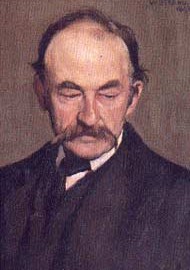
Story and Vision in the Poetry of Thomas Hardy

Story and Vision in the Poetry of Thomas Hardy

Laurence Coupe

E-Magazine 45 (September 2009), pp 35-38

Laurence Coupe discovers that the typical Hardy poem illuminates a moment set against a narrative framework. He argues that it is the tension between them that produces its special kind of beauty.

***

Conventionally poetry is divided into lyrics (short poems expressing an emotion or idea), narrative poems (telling a story) and dramatic poems (characters speaking as if in drama).   But this rigid distinction doesn’t always apply. We might think in particular of the poetry of Thomas Hardy, a poet whose works often look like lyrics but have an underlying narrative or dramatic impetus that is often missed. In the ‘Preface’ which he wrote for his second volume of poetry, Poems of the Past and the Present (1901), Thomas Hardy declared: ‘Of the subject-matter of this volume – even that which is in other than narrative form – much is dramatic or impersonative even where not explicitly so.’


It is important to bear this in mind as one approaches Hardy’s poems: even if they do not announce themselves as stories, there is a lot more going on in them than the poet simply telling us how he feels or what he believes. The title of that volume gives us a clue: one of Hardy’s main concerns is the relation between ‘past’ and ‘present’. Given that we live in time, we inevitably make sense of our lives through narrative. This is something that he, more than nearly all other ‘lyric’ poets, fully understands.


Note also Hardy’s use of the word ‘impersonative’. Typically his own invention,  he uses it to suggest a character, with his or her own story, as if in a play or novel. Before Hardy established himself as a poet he had already had a long and successful career as a writer of prose fiction. Indeed, many were written while he was still making his way in that genre. There is certainly something of the novelist’s skill evident in the poems, which seem deliberately to defeat our expectation of pure lyrical utterance. There is always some other sort of narrative ‘business’ going on, even when we assume that Hardy is simply expressing himself.


True, Hardy in his notebook once quoted approvingly his friend Leslie Stephen’s opinion that the aim of the poet should be ‘to touch our hearts by showing his own’. But ‘showing’ is a lot more subtle a process than ‘telling’, as any good novelist knows. It demands that the reader be drawn into the story, sympathise with the protagonists and enter into the world they inhabit.

Fools of time

No matter how closely a poetic utterance may seem to reflect whatever information we have about his life, we have to be careful not to simply equate speaker and author. It is no coincidence that a form of which Hardy was particularly fond was dramatic monologue. Here the ‘I’ is that of an impersonated character, who speaks in a specific setting and situation to another, silent character.


The classic instance of this form in Hardy’s work is the series of poems he wrote after the death of his first wife, Emma, and included in the section entitled ‘Poems of 1912-13’ in the volume Satires of Circumstance (1914). Of course, it would be foolish to deny that there is a connection between that event and that series of poems. However, it would be wrong to assume that each and every utterance is simply the expression of personal grief coming directly out of the experience of marital mourning. Hardy takes personal experience and crafts it into a more universal expression of bereavement.


We should not be misled here by Hardy’s use of the word ‘satire’ in the title just mentioned. If, in the conventional sense, it brings to mind poetry that exposes the folly of individuals and institutions, we should consider the effect of pairing it with the word ‘circumstance’. Shakespeare’s Sonnet 116 may declare ‘Love’s not time’s fool’, but what Hardy seeks to demonstrate is that most of us are indeed the fools of time, especially when falling in and out of love. ‘Circumstance’ – by which he means the uncontrollable conditions of mortal life – will always render us vulnerable and frequently ridiculous. But of course Hardy’s ‘satires’ are wholly his own, and are informed by his profound compassion.


In ‘The Going’, the persona begins by trying to justify himself for not realising, right up to the moment of death, that the deceased was fatally ill:

Why did you give no hint that night
That quickly after the morrow’s dawn,
And calmly, as if indifferent quite,
You would close your term here, up and be gone….

These lines expose his fallibility, but the ultimate point of the poem is to convey the depth of his regret, as is made clear in the desperation of the rapidly rhyming, shorter lines which succeed these:

Where I could not follow
With wing of swallow
To gain one glimpse of you ever anon!


Using a different verse form, but with similar effect, ‘The Voice’ conveys the abject state of mourning, the failure of the bereaved soul to find sanctuary from his pain: ‘Woman much missed, how you call to me, call to me…’ The abrupt generality of ‘woman’ compels our attention. The alliteration of ‘much missed’, intensifying the loss, is complemented by the repetition of ‘call to me’, whereby the echo of the words uttered only raises the cruelly taunting possibility that it is the beloved’s voice which is replying to him. ‘Can it be you that I hear?’ he desperately asks.  Memories of happier days, when the ‘woman much missed’ would wait for him, wearing her distinctive ‘air-blue gown’, only add to the speaker’s torment. Such memories fuel his obsessive quest for the absent one, and we are left with a vivid presentation of his state of bewildered loss, enacted by the uncertain verse form:

Thus I; faltering forward,
Leaves around me falling
Wind oozing thin through the thorn from norward
And the woman calling.

‘Never again’

We may rightly categorise ‘The Going’ and ‘The Voice’ as dramatic monologues: there is a speaker (the bereaved one), and there is a silent listener, silent in this case because dead (the loved one). However, each poem implies a larger framework of narrative, a past state in which the man and woman were happy together, contrasted with a present state in which they are apart. Hence the desperate wanderings of the persona in ‘The Voice’ to locate a bodily presence which offers more than the mere echo of his own words.


In the case of ‘The Going’, the relationship between past and present, and so the overarching narrative, is rather more complex. For we have three, not two, moments in time to consider. The first is the distant past when the young man and the young woman were blissfully happy:

You were the swan-necked one who rode
Along the beetling Beeny Crest,
And, reining nigh me,
Would muse and eye me,
While life unrolled us at its very best.

The second is the recent past in which the mature man and woman became estranged:

Why, then, latterly did we not speak,
Did we not think of those days long dead,
And ere your vanishing strive to seek
That time’s renewal?

The third is the present, in which the persona is tormented by the contrast between the first and second moments:

Well, well! All’s past amend,
Unchangeable. It must go.


The sense of a narrative context is important for understanding another of the ‘Poems of 1912-13’: ‘At Castle Boterel’. Here, though, the temporal setting is slightly different. Firstly, we have the personal memory – that of the occasion when, in ‘dry March weather’, the persona and his beloved got down from the chaise they were being driven in, to ease the pony’s load, and simply enjoyed climbing the road together. Though this may seem a trivial enough incident, the persona begs to differ:

But was there never
A time of such quality, since or before,
In that hill’s story?

Secondly, we have the persona’s present lament: visiting Castle Boterel again, the persona imagines that he sees a ‘phantom figure’, that of the beloved, in the very same spot as she was when with him, all those years previously. He can only

… look back at it amid the rain
For the very last time; for my sand is sinking,
And I shall traverse old love’s domain
Never again.

However, both moments, that of memory and that of lament, are placed in the context of a larger temporal framework:

Primeval rocks form the road’s steep border,
And much have they faced there, first and last,
Of the transitory in Earth’s long order.

The particular story concerning the persona’s quest is seen against the background of the larger movement of events, which is subject to ‘Time’s unflinching rigour’. Human beings have to make what sense they can of their lives through telling their stories, while remaining aware that there is a larger story which contains theirs. They may defy it, as does the persona when he affirms that what the rocks ‘record in colour and cast / Is – that we two passed.’ But the closing phrase of the poem, ‘Never again’, gives the last word to ‘Time’.

‘Looking away’

Again and again, Hardy presents us with situations and stories in which characters find themselves subject to the cruelties of life in time. He shows us how we carry our stories around with us, and how they can dictate how we respond to the given moment. Much of our emotional energy is spent in our anguish about what has been and what might yet be. In ‘A Broken Appointment’, the persona is waiting for a woman who fails to meet him as promised, thereby showing she did not care for him. He describes himself as ‘a time-torn man’. In ‘The Self-Unseeing’ the adult speaker recalls a childhood occasion on which he danced to the sound of his father’s violin while his mother sat looking on:

Childlike, I danced in a dream;
Blessings emblazoned that day;
Everything glowed with a gleam;
Yet we were looking away!


Of the two poems just quoted, the first might be categorised, along with ‘The Going’, ‘The Voice’ and ‘At Castle Boterel’, as a dramatic monologue. The speaker addresses an absent personage, who may or may not be listening (most likely not, it seems). The second poem belongs to the broader category of the lyric. We use the term ‘lyric’ to refer to most short poems expressing a state of mind or feeling. While the poet may not adopt a role, as in dramatic monologue, it is still necessary to remind ourselves that the speaker is not necessarily the same as the poet: the ‘I’ may well be ‘impersonative’. Just as importantly, even though the lyric may offer itself as an isolated moment of reflection – on an event, on another person, or on a theme – there will inevitably be an implicit narrative.

‘Some blessed Hope’

Sometimes the parameters of time are suggested by the title itself. In ‘Afterwards’, the title suggests that the present will in due course become the past; what takes place now will be reflected upon ‘afterwards’. With the first stanza, what is implicit in the title becomes explicit:

When the Present has latched its postern behind my tremulous stay,

And the May month flaps its glad green leaves like wings,

Delicate-filmed as new-spun silk, will the neighbours say,

‘He was a man who used to notice such things’?

The persona is envisaging a future when he will not be here: the gate of the present moment will have been shut for ever; he will, in short, be dead. The question that occurs to him is this: when that has happened, will other people look out onto the sights of their world – the fragile beauty of Spring, in this instance – and remember him fondly as someone who, while he was alive, appreciated them – and, perhaps, taught others to do so? Or, to put this in another way again: in the future he will belong to the past; but will his name be invoked by way of a reminder to live in the present? He trusts that, though his question is here a rhetorical one, it will be answered positively in due course.


Narrative for Hardy is not always confined to individual lives. ‘The Darkling Thrush’, first published in The Times on 29th December 1900, and subsequently included in Poems of the Past and Present, takes history itself as its context, the bigger narrative in which people’s private narratives are positioned.


Though this is a lyric poem, it also has a narrative trajectory. The persona has been wandering amidst the bleak and gloomy setting of the countryside in winter, and now pauses to look about him:

I leant upon a coppice gate
When frost was spectre-gray.

He cannot help but project human qualities onto the scene and, simultaneously, the historical context:

The land’s sharp features seemed to be
The Century’s corpse outleant,
His crypt the cloudy canopy,
The wind his death-lament.


The direction of human history, as of individual life, is towards the ‘winter’ of death – the decline of civilisations, the encroachment of mortality. However, halfway though the poem Hardy brings in a contrary vision: the persona, who describes himself as ‘fervourless’, without passion or enthusiasm, becomes aware of ‘a full-hearted evensong / Of joy illimited.’ His melancholy sojourn has been rewarded, it seems. Out of the death of the year, the death of the century and the death of the persona’s spirit there arises, suddenly and miraculously, the promise of new life. This is all the more surprising since it emerges from the gloom by way of an ‘aged thrush, frail, gaunt, and small / In blast-beruffled plume’. This moment of vision cuts across the narrative of despair: though there seems to be ‘so little cause for carolings / Of such ecstatic sound’ that the persona cannot help but conjecture that the thrush’s song signified:

Some blessed Hope, whereof he knew
And I was unaware.


The religious quality of the language – ‘evensong’, ‘carolings’ and, of course ‘Hope’ (here capitalised, it is one of the Christian virtues) – cannot help but suggest the possibility of redemption. Hardy, an agnostic, leaves the implications of this language hanging in the air, along with the bird’s song; and the poem itself lingers in our minds. Is it possible that life is more than a story that ends in defeat? Hardy himself is silent; his persona is ‘unaware’.


But the point is that ‘The Darkling Thrush’, like so many of his other poems, continues to offer its readers a sense of the poignant beauty of the world, always accessible even where the narrative we inhabit seems remorselessly tragic. Insofar as we remain open to that beauty, and revere it, human life is justified and the poet’s work has not been in vain.

Laurence Coupe


The Presence of the Past in WAITING FOR GODOT


The Presence of the Past in 

Waiting for Godot

Laurence Coupe

The English Review, 5, 1 (September 1994), pp. 19-22


This article relates a particular literary past to the present of Beckett’s play. Taking his cue from T.S. Eliot’s essay ‘Tradition and the Individual Talent’, Laurence Coupe demonstrates how Beckett ‘takes on’ canonical texts (Shakespeare, Dante, the Bible). Far from these being academic allusions, Beckett manages to treat them as vitally relevant to his own needs and to appropriate them for our own age.

***

Samuel Beckett’s Waiting for Godot, though about half a century old, is still regarded as a very strange play. To acknowledge what is familiar about it need not deprive the play of its power; rather, it might help affirm its creative credentials. For if we still find it challenging, this is surely something to do with its radical relation to established literary texts. As T. S. Eliot pointed out in his influential essay of 1919, there is no easy way to separate ‘Tradition and the Individual Talent’. The literary legacy — the ‘canon’ — would become a dead weight were it not for those modern writers who, far from evading it, make it crucially relevant to their own needs. Beckett is one such writer: with him the past becomes present.

Welcome to Purgatory

Waiting for Godot, then, must be seen in context. Indeed, there is a context announced for it already, in the author’s own earlier work. I am thinking of his short story ‘Dante and the Lobster’, included in Beckett’s first prose volume More Kicks than Pricks (1934). The plot centres on a day in the life of one Belacqua Shuah, a Dublin student researching into Dante’s Divine Comedy, a major visionary poem of the early fourteenth century concerning the afterlife.

Belacqua is attracted to that text because he likes pondering the themes of damnation and salvation; in the poem Dante imagines himself travelling from the depths of Hell to the heights of Heaven. Moreover, Shuah has an affinity with it because he shares his own first name with that of one of Dante’s characters: the figure whom the poet meets as he travels up the Mount of Purgatory, which lies halfway between the infernal and celestial realms. Dante’s Belacqua is being punished for the sin of idleness, which means that he delayed his repentance until the very last moment. Now he is forced to repent at length, lingering alone on the mountain, with the bliss of heaven a long way off.

Here in this world, Beckett’s Belacqua also lingers and loiters a good deal. Indeed, it takes him all his time to prepare his lunch (burnt toast, gorgonzola, salt, mustard and cayenne) and then to collect a lobster from the fishmonger for his aunt. After several awkward episodes, he arrives at her house, where he is surprised to find that the creature is still alive. His aunt mocks him for his naivety, explaining how lobsters are cooked as she prepares it for the pan of boiling hot water. The story ends as follows:

She lifted the lobster clear of the table.

It had about 30 seconds to live.

Well, thought Belacqua, it’s a quick death, God help us all.

It is not.


‘Dante and the Lobster’ gives us Beckett’s vision in brief. Living is a matter of suffering, as in purgatory, but without the consolation of an assured future. All one knows for certain — though, like Belacqua Shuah, we may try and take refuge in cliche — is that life is long, and pain is profound. The name of Dante may not have been on the lips of all the critics when Waiting for Godot was first performed in English in 1955. But perhaps we can see, with the advantage of having the complete works, that the familiar landscape of all Beckett’s writing is the Mount of Purgatory, as depicted in the second of the three books of The Divine Comedy. Again and again, his characters are ‘waiting’, as Vladimir and Estragon wait for ‘Godot’. And we do not even crudely have to identify that elusive figure with the God whom the nineteenth-century philosopher Friedrich Nietzsche announced to be dead, in order to see that between Dante and Beckett the emphasis has shifted. Where once Purgatory was the route from Hell to Heaven — a stage on the journey of redemption — it now marks the boundaries of our meaningless and intolerable lives.

Consider Lucky’s tortuous speech in Act I of Waiting for Godot. If, in essence, his is a theo­logical argument such as we frequently find in Dante, it is one that is taking place after the death of God. Though we constantly assume the existence of a sky-father who ‘for reason unknown’ rewards some souls and punishes others, humanity is seen to ‘waste and pine’. Though we seek to blind ourselves to this truth by physical activity, we will, ‘in spite of… the tennis’, eventually have to face the fact that we live in an ‘abode of stones’.

When in Act II Pozzo and Lucky appear for the second time, and soon collapse in a helpless heap on the ground, Vladimir is delighted because this gives him and Estragon something to do, relieving the tedium of their existence. He desperately enthuses to Estragon:

Vladimir: We wait. We are bored. [He throws up his hand.] No, don’t protest, we are bored to death, there’s no denying it. Good. A diversion comes along and what do we do? We let it go to waste. Come, let’s go to work! [He advances towards the heap, stops in his stride.] In an instant all will vanish and we’ll be alone once more, in the midst of nothingness!

Thus our condition, in this ‘abode of stones’, is revealed to be paradoxically both purgatorial and purposeless. Beckett’s vision derives from Dante’s traditional Christian universe; but without divine meaning the cosmos turns out to be chaos.

If Eliot is right about tradition then what both ‘Dante and the Lobster’ and Waiting for Godot have allowed us to do is to read the present in terms of the past and the past in terms of the present. Belacqua in Purgatory, in no hurry for salvation, has now caught something of the character of Belacqua in Dublin, burning his toast and reluctantly fetching his aunt’s lobster. Nor can the landscape of Purgatory itself ever be the same now that we have seen Vladimir and Estragon, tormented by time, as they wait by a bare tree on a bleak country road.

‘Do not presume…’

Behind Waiting for Godot lies The Divine Comedy; behind The Divine Comedy lies the Bible. The scriptures too are invoked by Beckett. But the experience of the play is not that of catching the odd, disposable allusion; rather, a pattern starts to emerge. Early in Act I Vladimir, having been ticked off by Estragon for leaving it too long to empty his bladder, quotes a half-remembered line: ‘Hope deferred maketh the something sick, who said that?’ His friend neither knows nor cares, being preoccupied with his boots, but the reference is vital. Turning to the Biblical source we read the following: ‘Hope deferred maketh the heart sick, but when the desire cometh, it is a tree of life’ (Proverbs 13:12).

Here we need to remind ourselves that in the beginning, the Bible tells us, Adam and Eve lived in the Garden of Eden and did not know suffering or death. Then, prompted by the serpent, they chose to defy God and eat the fruit of ‘the tree of the knowledge of good and evil’. The result was that they were driven out of the garden, and the way was barred to ‘the tree of life’ (Genesis 2-3). Vladimir and Estragon have inherited this loss. The road they are travelling leads nowhere; and though the tree by which they wait, which is bare throughout Act I, suddenly in Act II acquires ‘four or five leaves’, this is hardly a guarantee that the ‘life’ of Eden has been restored. Moreover, though Vladimir may remark at the end of the play that ‘Everything’s dead but the tree’, his and Estragon’s main interest is whether or not it will do to hang themselves on: it will not. Contrast this painful symbolism with Dante’s welcome of a sure sign of salvation coming out of suffering: ‘The tree renewed itself, which before had its boughs so naked’ (Purgatory, XXXII, 59-60).

So all our two wanderers are left with is the realisation that they have fallen:

Estragon: We’ve lost our rights?
Vladimir [distinctly]: We got rid of them.

Significantly, when the former is asked by Pozzo for his name, he replies ‘Adam’. Again, when Estragon later tries to attract the attention of Pozzo and Lucky by calling out ‘Abel’ and ‘Cain’ (the names of Adam and Eve’s sons), Pozzo responds to both titles: as Estragon remarks, ‘He’s all humanity.’ In other words, he has unknowingly admitted our fallen condition, in which we are all as much capable of evil (Cain) as of good (Abel).

But what of Christ, and the possibility of redemption? Vladimir is certainly interested in the crucifixion, and the story of the repentant thief; or, at least, he hopes that telling it ‘will pass the time’:

Vladimir: Two thieves, crucified at the same time as our Saviour. One –
Estragon: Our what?
Vladimir: Our Saviour. Two thieves. One is supposed to have been saved and the other…  [he searches for the opposite of saved] … damned.


In a rare interview Beckett once quoted St Augustine’s reflection on this story: ‘Do not despair, one of the thieves was saved: do not presume, one of the thieves was damned.’ What appealed to him, he said, was ‘the shape’: a typically ambiguous observation, since the symmetry of the statement allows for it to be read both optimistically and pessimistically. On the whole, of course, the evidence of Waiting for Godot is that Beckett’s interpretation of what is often called the good book is decidedly gloomy. When Estragon compares himself to Christ, Vladimir objects (typically, on geographical rather than theological grounds):

Vladimir: Where he lived it was warm, it was dry!
Estragon: Yes, and they crucified quick!

Unaccommodated man

However negative the Biblical context of Waiting for Godot, one could hardly accuse Beckett of avoiding the challenge of the scriptures. The faith to which they testify may not be available to him, but they offer a pattern of meaning against which to test his despair. Dante is re-read in a similar way. If we look carefully, we might also detect the presence of Shakespeare, another pillar of the tradition. Indeed, in this case the influence might, at first, seem even more direct. But again, we have to be careful in comparing source and use.

Take King Lear. In Act 3 the old king, driven to madness, wanders on the heath followed by the motley entourage of his Fool, the banished Earl of Kent and ‘Poor Tom’ (the Duke of Gloucester’s maligned son, in disguise as a beggar). The dialogue reaches heights of absurdity comparable to that of Vladimir and Estragon, Pozzo and Lucky (another quartet of misfits); but again, mixed in with the madness are moments of awful truth. Pointing to ‘Poor Tom’ and appealing to the other three, Lear asks:

Is man no more than this? Consider him well. Thou ow’st the worm no silk, the beast no hide, the sheep no wool, the cat no perfume. Ha! There’s three on’s are sophisticated; thou art the thing itself; unaccommodated man is no more but such a poor, bare forked animal as thou art. (III.iv.105-11)

At such moments of insight in the bleak, storm-tossed wilderness we may not feel there is much effort needed to see Beckett as traditional. Waiting for Godot seems to be exactly about this vision of humanity.

We may recall also the last great speech by the blood-steeped hero of Shakespeare’s Macbeth. Besieged in his castle and hearing of his wife’s death, he manages to attain a lucidity as terrifying as that of the old king on the heath:

Life’s but a walking shadow; a poor player,
That struts and frets his hour upon the stage,
And then is heard no more: it is a tale
Told by an idiot, full of sound and fury,
Signifying nothing. (V.v.24-28)

Could there be a better description of the progress of Vladimir and Estragon throughout the two acts of Waiting for Godot?

Indeed, Vladimir’s own conclusions are not unlike Lear’s and Macbeth’s. Remembering Pozzo’s insight (‘They give birth astride of a grave…’), he elaborates:

Astride of a grave and a difficult birth. Down in the hole, lingeringly, the grave-digger puts on the forceps. We have time to grow old. The air is full of our cries. [He listens.] But habit is a great deadener. [He looks again at Estragon.] At me too someone is looking, of me too someone is saying, he is sleeping, he knows nothing, let him sleep on. [Pause.] I can’t go on! [Pause.] What have I said?

Absurdity then and now         

Do we conclude, then, that whereas the Bible and Dante have to be forcibly taken over by Beckett, his world-view has already been anticipated exactly by Shakespeare? This would be, I feel, misleading. For the vision of ‘unaccommodated man’ is Lear’s, not the author’s of King Lear; and the vision of the ‘tale / Told by an idiot’ is Macbeth’s, not the author’s of Macbeth. After all, the last words of both works go to other characters, representa­tives of a new beginning. Moreover, the same playwright also wrote Much Ado About Nothing and Twelfth Night: festive comedies, in which such nihilism is very firmly put in its place. By contrast, Vladimir speaks — if the evidence of Waiting for Godot as a whole, and ‘Dante and the Lobster’, is to be believed — with Beckett’s full authority.

Another way of putting this is that, though the absurd vision is only one dimension of Shakespeare’s repertoire, in our age it has become central. Thus, while the great tragedies may offer Beckett a model of despair, he can only use it by extending it beyond the dramatic limits originally imposed. An insight born of extremes — Lear’s anguish, Macbeth’s guilt — has been treated as absolute and universal. Shakespeare too has had to be read against the grain. But then, this is just the kind of daring that we need from an ‘Individual Talent’ if ‘Tradition’ is to be kept alive.

Laurence Coupe


DEATH OF A SALESMAN: What’s Wrong with Willy Loman?

Death of a Salesman:

What’s Wrong with Willy Loman?

Laurence Coupe

The English Review, 5, 4 (April 1995), pp. 16-19


The hero of Arthur Miller’s play Death of a Salesman is nobody special, yet we feel his life and tragic death to be deeply significant. Laurence Coupe argues that the clue might be ‘ideology’. Willy Loman sacrifices himself for exactly those beliefs and values which are the ‘common sense’ of our own competitive society.


***

John Lennon’s song ‘Working-Class Hero’ has a verse which runs as follows:

There’s room at the top, they are telling you still,
But first you must learn to smile as you kill,
If you want to be like the folks on the hill …

The ‘working-class hero’ of its title is told that if he is sufficiently ruthless, he too will be able to make it to the ‘top’ in the rat race.

At first sight this song might seem to sum up the way in which ideology works: indoctrination by an external force which programmes the individual to behave according to certain patterns and expectations. But ideology functions in ways more complicated than those at which Lennon’s lyric hints. What is actually involved is a largely internal, unconscious process. Ideology consists of our routine responses to the world; it is that view of ourselves and society that we take for granted as given. Literary texts are often engaged with exploring the inner life, so can be a useful way of showing the way in which ideology works. There again literary works cannot always be simply categorised according to whether they confirm ideology on the one hand or challenge ideology on the other. Sometimes one work can do both things at the same time. Arthur Miller’s most famous play, Death of a Salesman (1949), seems to me a sin­gular example of this.

Worth more dead than alive

Willy Loman is not strictly speaking a ‘working-class hero’: more a ‘lower middle-class hero’, which of course makes him less likely to become the subject of a protest song. But he is certainly an oppressed figure, a victim. As such, he has fantasies of a better life. These are indicated in Miller’s stage directions at the beginning of the play: ‘A melody is heard, played upon a flute. It is small and fine, telling of grass and trees and the horizon.’ Willy’s late father, we will learn, made and sold flutes, travelling across the wide-open spaces of North America as his own man, an embodiment of the pioneer spirit. That life, represented by the motif of melody, is the one Willy has failed to find or realise for himself. Hence, Miller tells us, an ‘air of the dream’ clings to the Lomans’ house and yard: ‘a dream rising out of reality’. We might call that dream ‘ideology’.

Miller could have constructed his play so that the dream dissolves and reality is faced directly. But that would have resulted in a naively optimistic drama. Rather, he shows us the hero’s commitment to the dream — the belief that ‘personality always wins the day’ and success comes to those prepared to sell not only goods but also themselves — intensifying to the point where, given the manifest failure of his life, he can only seek victory in death.

The plot of Death of a Salesman is constructed to direct our attention to this climax. It covers the last 24 hours lived by Willy Loman. Finding that travelling around as ‘the New England man’ exhausts him at his advanced years, he is persuaded by his wife Linda to ask his boss Howard Wagner for a more convenient position at the New York office of his firm. The young and insensitive Howard refuses this request and Willy, driven to despair, concludes that he is ‘worth more dead than alive’. He then deliberately kills himself in a car crash in order that his wife and family will benefit from his insurance policy. In particular, his elder son Biff will inherit the house in which Willy has invested so much financially and emotionally.

Death of a Salesman can to some extent be read as an indictment of an external system called American capitalism. Take the scene in which Willy, who repeatedly experiences past moments as vividly as if they were present, relives the jubilant visit of his own elder brother Ben. Returning from the diamond mines of Africa, Ben proudly tells young Biff and his brother Happy: ‘Why, boys, when I was 17 I walked into the jungle, and when I was 21 I walked out. [He laughs.] And by God I was rich.’ So we may infer that the world of the capitalist is that of Ben’s ‘jungle’, to succeed in which it is best — as Ben puts it, having tripped Biff up in a mock boxing match – ‘never’ to ‘fight fair with a stranger’. In John Lennon’s words, you must ‘smile as you kill’ in order to be ‘like the folks on the hill’.

But a full response to the text would have to go further than that. For a start, Willy’s next­door neighbour Charley, though a successful capitalist, is a benign one: so much so that he actually supports Willy by ‘loans’ that he knows will probably never get paid off. Of course, the exception could be said to prove the rule — which might be better represented by Howard Wagner who, if not malicious, seems to have been trained very thoroughly in the art of indifference. Willy pleads with him in vain:

You mustn’t tell me you’ve got people to see – I put 34 years into this firm, Howard, and now I can’t pay my insurance! You can’t eat the orange and throw the peel away – a man is not a piece of fruit!

But we would not find the plays of Arthur Miller so challenging if all they did was tell us that there are people like Howard. What is much more important than the external depic­tion of a ruthless economic order is the explo­ration of an internal world: the sphere where illusion takes place. (The original title of Death of a Salesman was ‘The Inside of his Head’.)

Fathers and sons

It is important to note that when Willy appeals to Howard, all he has to rely on is the past. Indeed, the fascinating structural feature of the play itself is that it allows a constant interpenetration of two moments: real time and remembered time. We have already noted, for example, that the boasting, advice and foul play of Ben, though all in the past, is reenacted in the present. This is because Willy himself — who is the centre of consciousness in the play — finds it increasingly hard to tell the difference. In technical terms, Miller is fusing the traditional social drama known as ‘naturalism’ with the more adventurous psychological drama known as ‘expressionism’. But what matters is the insight into ideology: not only does it serve the status quo, the way society seems always to have been, but it also traps individuals in their own permanent pasts, obscuring the possibilities of the future. Significantly Willy, who has functioned by deceiving himself (‘Business is bad, it’s murderous. But not for me, of course’), comes to such realisation as he does about his plight when, declaring to Biff after the interview with Howard Wagner that ‘I was fired’, he reflects: ‘The gist of it is that I haven’t got a story left in my head…” Ideology is the story we tell ourselves rather than face the reality of our situation.

It is because Miller is more interested in tracing the psychological roots of oppression than in producing a propagandist drama that he focuses so much on the family. The crucial relationship here is between fathers and sons. For if we are bound to the past, it is largely through our relationships with our parents. Willy in the present of the play is the father, but in the still-active past he is the son: prompted by the sound of his father’s flute and by the ghostly presence of his elder brother — in effect a father-figure — he is helpless within time, condemned to repeat himself interminably. Hence his tediously reiterated insistence that the only way to succeed is to be ‘well-liked’. This immature faith shelters him from the actuality of, on the one hand, the success of Charley and his son Bernard (not ‘liked’), and on the other, from the failure of himself and of Biff and Happy (definitely ‘liked’). Such repetition of what seems to him obvious but which is in fact false, along with the empty salesman’s slang which Miller captures so convincingly (‘You guys together could absolutely lick the civilised world’), keeps this ‘low-man’ (‘Loman’) down where he is, and always was. After all, the very name ‘Willy’ is infantile, signifying a refusal to grow up.

If Philip Larkin is right that ‘Man hands on misery to man’ (‘This be the verse’), then Willy’s sons, encouraged to keep their own equally immature nicknames (‘Biff’ and ‘Happy’) into adulthood, both seem condemned to repeat their father’s failure and relive his self-deception. But families are always more complicated than that.

‘I know who I am’

If we are to discuss the effect of Willy on his children, we must carefully distinguish between Happy and Biff. The former enjoys the less complex influence. He can dismiss Willy callously when his disturbed behaviour in the restaurant proves embarrassing in front of two ‘girls’ whom the ‘boys’ have been trying to impress: ‘No, that’s not my father. He’s just a guy.’ Paradoxically, it is he also who in the final ‘Requiem’ can pronounce: ‘He had a good dream. It’s the only dream you can have – to come out number-one man.’ Either way, we may conclude that Happy is condemned to repeat Willy’s error: after all, the callousness is only consistent with the ideology of self–interest within which he has been raised.

Biff, however, is both closer to and more distant from his father. Early on, Happy observes that when Willy is talking to himself, ‘Most of the time he’s talking to you.’ And indeed, theirs is the crucial relationship as far as the plot development is concerned. Willy’s anxiety about Biff’s career failure  – which results from the son’s traumatic discovery of the father’s extra-marital affair – is crucial to his decline. And it is, ironically, only after believing that he has at last regained some filial affection that Willy feels strong enough to make his ultimate sacrifice:

Willy [after a long pause, astonished, elevated]: Isn’t that — isn’t that remarkable? Biff — he likes me!
Linda: He loves you, Willy!
Happy [deeply moved]: Always did, Pop.
Willy: Oh Biff! [Staring wildly] He cried! Cried to me. [He is choking with his love, and now cries out his promise] That boy — that boy is going to be magnificent!

But even as Willy feels closest, he is furthest apart. His last assertion demonstrates that he has learnt very little; he is still fooling himself. He can only envisage Biff in the simplistic language of football heroics which he has always used (‘When the team came out — he was the tallest, remember?’) Of the two, it is the son who has advanced, who has understood:

I am not a leader of men, Willy, and neither are you. You were never anything but a hard-working drummer who landed in the ash-can like the rest of them! … I’m not bringing home any prizes any more, and you’re going to stop waiting for me to bring them home! … Pop, I’m nothing! I’m nothing, Pop. Can’t you understand that? … Will you take that phoney dream and burn it before something happens?

Indeed, of all the characters in the play, it is only Biff who earns the right to declare, during the ‘Requiem’, that ‘I know who I am.’ Charley, the benign capitalist, can only offer a senti­mental justification of a salesman’s ‘dream’ (‘It comes with the territory’); Happy vows to prove that ‘Willy Loman did not die in vain’; and Linda is left sobbing pathetically, ‘We’re free …. We’re free…’

From past to future?

What Linda means, of course, is that the house has been paid for: the family are ‘free and clear’ from that particular financial constraint. But otherwise, the final impression is of a life going on much as before, with most characters sharing Willy’s illusions. Ideology, we have already said, binds people to the past. Its opposite — what we call ‘utopia’, the vision of the future — is scarcely glimpsed in the play. Only Biff, with his refusal of the salesman’s role and his resolve to move away from the world of urban capitalism, offers anything like an alternative conviction:

I stopped in the middle of that building and I saw — the sky. I saw the things that I love in this world. The work and the food and time to sit and smoke.

The final question, then, is how far is this vision valid? Given that the play’s title (‘a salesman’ not ‘the salesman’) indicates that Willy is not meant to be regarded as isolated and exceptional, we may fairly grant Biff as much right as his father to the ultimate recognition of the play, to its tragic enlightenment.

Given that the elder son is the one who has seen through the Loman lie, what credence can we give his own vow of authenticity? On the one hand, Biff’s alternatives could be seen as Miller’s ideals: creative labour, not selling oneself; a natural environment, not the demonic metropolis. On the other hand, the very same ideals are evoked by the flute music which recurs throughout the play, which is identified with the pioneer spirit of the father whom Willy wishes so much to emulate. There is an ambiguity here. Moreover, Ben’s ruthless acquisitiveness is conveyed in such a way as to deepen that ambiguity: the ‘jungle’ signifies not only the escape into nature and freedom but also the very workings of urban capitalism itself.

If we have ended by demonstrating the playwright’s perspective to be implicated in the confusion of his times, that is only to be expected. Literary works may expose and question ideology, but they are themselves ideological. What is wrong with Willy Loman is what is wrong with all of us, reader and author alike. It is never possible simply to transcend the illusions of the age. Utopia, which really means ‘nowhere’, cannot be envisaged directly. It is only available to us through the inarticulate hopes of a Biff: beyond that, through the complex — and necessarily contradictory — vision of a play like Death of a Salesman.

Laurence Coupe

Violence and the Sacred: MURDER IN THE CATHEDRAL

Violence and the Sacred:

Murder in the Cathedral

Laurence Coupe

The English Review 6, 2 (November 1995), pp. 28-31


Is it possible that, with Murder in the Cathedral, T. S. Eliot achieves the impossible: a perfectly coherent religious play for the twentieth century? Laurence Coupe expresses doubts about the coherence, but still finds the play compelling.

***

Two years before T. S. Eliot’s play Murder in the Cathedral was staged for the Canterbury Festival of June 1935, he gave a lecture on the Victorian poet and critic Matthew Arnold. Arnold had proclaimed: ‘No one can deny that it is of advantage to a poet to deal with a beautiful world.’ Eliot disagreed: the task of the poet was ‘to be able to see beneath both beauty and ugliness; to see the boredom, and the horror, and the glory.’ When, having established his reputation in secular verse, Eliot turned to creating a religious drama, he did not necessarily abandon this threefold principle. Though Murder in the Cathedral is designed to celebrate the ‘glory’ of God and his world, it does so in the context of the ‘boredom’ and the ‘horror’ of human experience.


Greek form, Christian meaning

The first ‘character’ we meet in the play is collective: it is ‘a Chorus of women of Canterbury’. This is a convention borrowed from classical Greek tragedy. The women fulfil the traditional function of reporting events so far:

Seven years and the summer is over,
Seven years since the Archbishop left us,
He who was always kind to his people.

This reportage is, of course, really only a reminder: as with Greek tragedy, the story is already known, and we are starting very near its end. Sophocles is not setting out to surprise his audience by the audacity of his plot with Oedipus Rex; he is retelling and restructuring familiar material. Similarly, Eliot is addressing people who know full well that in 1170, in the very cathedral where they are gathered, Thomas Becket, Archbishop of Canterbury, returned from exile in France after refusing to surrender church authority to state power, only to be murdered by King Henry II’s knights.


In both cases — Sophocles’ and Eliot’s — the fact that there is a chorus with whom to iden­tify and that the outcome is known offers the advantage that the audience is a truly informed one. On the other hand, the suspense we may feel when watching Shakespeare, as an Othello or a Macbeth agonises and blunders his way through his dramatic crisis, is missing. Here there is no significant choice. Oedipus has already married his mother and killed his father when the play begins: all that remains is for him to realise that it is this double error which has brought the plague on Thebes. Thomas has already made the decision to return to England and so to certain death: as he says himself, ‘I have therefore only to make perfect my will.’


But there is one major difference between the two dramas, and that is Eliot’s Christianity. The play is taking place in a church: the Chorus is also a choir; there are three Priests standing by; Thomas will be attacked spiritually by four Tempters before he is attacked physically by four Knights. Moreover, the play incorporates liturgical prayers and chants (Te Deum, Dies Irae etc) and is divided into two by the sermon which Thomas delivers on Christmas Morning. Thus the audience is also a congregation, and what is at issue is not only a reminder of an important story, but a demand for a reaffirmation of faith.


The Chorus acknowledges itself as ‘type of the common man’, of the ‘small folk’ who ‘do not  wish anything to happen’, but it is ‘drawn into’ a larger ‘pattern’ and ‘forced to bear witness’. The demand is for us to make the same commitment. Like the women of Canterbury, we have been content with the ‘boredom’ of existence – ‘living and partly living’ — because, in Thomas’s words, ‘Human kind cannot bear very much reality.’ Now we, must be prepared to face the ‘horror’ that they face when they realise the murder has been committed:

We are soiled by a filth that we cannot clean, united to a supernatural vermin.

It is not we alone, it is not the house, it is not the city that is defiled,

But the world that is wholly foul.

Only then may we appreciate their final praise of God, when they see the world anew, having understood the meaning of martyrdom. Realising that ‘Thy glory is declared even in that which denies thee’ — the very darkness declaring ‘the glory of light’–  they reflect:

They affirm Thee in living; all things affirm Thee in living; the bird in the air, both the hawk and the finch; the beast on the earth, both the wolf and the lamb; the worm in the soil and the worm in the belly.

Blood for blood, death for death

If Murder in the Cathedral is ultimately a Christian ritual, and concerns the victory of the spirit, it gains its powerful effect from being rooted in the imagery of the earth. The opening of Part II is typical in its emphasis on the importance of the seasonal cycle and the desperate need for rebirth. The chorus cries out from the depths of the winter:

What sign of the spring of the year?
Only the death of the old; not a stir, not a shoot, not a breath.
Do the days begin to lengthen?
Longer and shorter the day, shorter and colder the night.


Christmas is, of course, also the pagan mid­winter solstice, and so it may seem fitting that the collective mind should turn to thoughts of ritual renewal:

And war among men defiles this world, but death in the Lord renews it,

And the world must be cleaned in the winter, or we shall have only

A sour spring, a parched summer, an empty harvest.

Thus we have to view Thomas simultaneously in two perspectives: as Christian martyr and as primitive sacrificial victim.


Eliot, long before he had become a Christian, had carefully studied the work of the Cambridge anthropologist Sir James Frazer. Frazer had argued that the origins of religion lay in fertility sacrifice, but unlike him Eliot thought that this conjecture, far from invalidating Christianity, gave it a greater credibility. It thereby had real foundations in archaic thinking. Hence the women of Canterbury fuse the two languages of fertility and faith:

We thank Thee for Thy mercies of blood, for Thy redemption by blood.

For the blood of Thy martyrs and saints

Shall enrich the earth, shall create the holy places.

For wherever a saint has dwelt, wherever a martyr has given his blood for the blood of Christ,

There is holy ground, and the sanctity shall not depart from it.

Thomas is in their eyes at once a god of vegetation, dying in winter to be reborn in the spring, and a Christian martyr who repeats the absolute atonement, the ultimate ‘Passion’ on the Cross, of Jesus Christ. He restores the crops even as he redeems the people’s souls.


No blasphemy is intended by Eliot. Indeed, Thomas explicitly argues, in his Christmas Morning sermon, that the essence of Christianity is sacrifice: ‘Is it an accident, do you think, that the day of the first martyr [St Stephen] follows immediately the day of the Birth of Christ? By no means. Just as we rejoice and mourn at once, in the Birth and in the Passion of Our Lord; so also, in a smaller figure, we both rejoice and mourn in the death of martyrs.’ As he approaches his own martyrdom, he states the case more vividly in verse:

This is the sign of the Church always,
The sign of blood. Blood for blood.
His blood is given to buy my life,
My blood given to pay for his death,
My death for his death.

The martyr is one who ‘bears witness’ to the Lord’s sacrifice by making his own. All he asks is that we — as represented by the Chorus — are prepared in turn to ‘bear witness’ to him.

Eliot’s ritual

The ambiguity of Murder in the Cathedral — that it ends in death but simultaneously ends in triumph — may be seen as reflecting the ambiguity of Christianity itself. Certainly Eliot is working on the premise that only Christ’s violent death can give life to humanity. We might want to label the play ‘Christian tragedy’, but it is noteworthy that Eliot himself does not do so. Nor, I think, will that often confusing term ‘tragi-comedy’ serve us: Waiting for Godot is now the twentieth-century model of that genre; and in Godot the two structures effectively cancel each other out, the ‘boredom’ over­whelming both ‘horror’ and ‘glory’.


It is tempting, then, to rest content with some such neutral term as ‘religious drama’; but even that raises its own difficulties. We know from Eliot’s own published speculations about the writing of plays that he did not approve of drama which explicitly addressed contemporary social issues, such as communism and fascism, unemployment and war. But did he succeed in producing a work which is exclusively religious? Is the ritual completely self-contained, and convincing as such?

Sacrifice and society

If the main interest of the plot is the martyr’s preparation for death and the people’s gradual understanding of the reasons for his sacrifice, then an important subsidiary interest is the conflict between church and state. Indeed, there would be no Murder in the Cathedral if there had not been that specific historical struggle between the King and his ex-Chancellor in the late twelfth century. Despite the fact that Eliot begins his plot right near the end of the story, he is very careful to get all the background details correct — as for instance in the speeches of the Tempters and the Knights. But more gen­erally the play also acknowledges a social con­text both deeper and wider: one of ‘boredom’ and ‘horror’ but precious little ‘glory’. The Chorus reflects:

There have been oppression and luxury,
There have been poverty and licence,
There has been minor injustice …
Several girls have disappeared
Unaccountably …

This is a world in which everything connects: not only as part of Thomas’s larger cosmic ‘pattern’ – ‘that the wheel may turn and still / Be forever still’ — but as part of a callous political order. The women of Canterbury are victims of habitual violence — exploitation, injustice, abuse — as well as witnesses of exceptional violence.


After the Knights kill Thomas they rationalise their action by appealing to the audience’s common sense: there must be ‘a just subordination of the pretensions of the Church to the welfare of the State’. That being the case, Thomas may be accused of provoking the attack, and our verdict must be ‘Suicide while of Unsound Mind’. This is the very language of the society depicted above by the women of Canterbury. On the one hand we are meant to note the irony: in invoking worldly justice to vindicate their sin they serve as mere agents of the divine plan, since there would be no martyrdom unless there were misguided people prepared to find reasons for murdering Thomas. On the other hand, we may doubt whether the play’s triumphant closure signifies the end of the systematic aggression represented by the Knights, it being the basis of the oppressive regime which they serve.


There are, then, two types of violence in the play. There is the endemic brutality of the social order, and there is the decisive act of martyrdom. The latter is meant to release us from the former. The critic Rene Girard would say that the distinction is between ‘impure’ and ‘pure’ violence. Discussing Oedipus Rex in his thought-provoking book Violence and the Sacred (1977), he argues that the ‘content’ which Sophocles inherits is an archaic story about identifying the one man who is responsible for the plague — that is, all the ills of the community — and then removing him. Oedipus is, as we say, the ‘scapegoat’. But the actual tragedy which Sophocles produces is less clear-cut: the impression we get is of a world where everybody is fighting everyone else, and in which Oedipus is not really so exceptional. Oedipus Rex enacts the tension between the desire to go back to one moment of ‘pure’ violence which will solve all our troubles, and the acknowledgement that ‘impure’ violence persists. But what, in this light, may we conclude about Eliot’s drama?

An end to violence?

The paradox of Thomas’s death, in Eliot’s version, is that, as murdered, he dies a criminal, a traitor, a madman; but as martyred, he dies a saint, a saviour, a witness to Christ. To the Knights he is a political embarrassment; to Christians everywhere, from the twelfth to the twentieth century, he represents ‘the Law of God above the Law of Man’. As the Third Priest puts it, on the very day of the death:

Even now, in sordid particulars
The eternal design may appear.

‘Impure’, everyday violence turns, miraculously, into ‘pure’, redemptive violence.


Thus we have to see Thomas preparing him­self for this moment, when sainthood emerges from ‘sordid particulars’. He has to be seen to be ritually tempted, four times — even over­coming the last and most grievous temptation, to ‘do the right thing’ (that is, die) for ‘the wrong reason’ (that is, spiritual pride). He has to be seen to acquire an understanding which takes him beyond the expediency of the Priests, who think that even at the last moment, as the Knights approach, they can bar the cathedral doors and prevent the murder:

It is out of time that my death shall be known;
It is out of time that my decision is taken
If you call that my decision
To which my whole being gives entire consent.

It is by separating himself from the business of not only the state but also the church (as a worldly institution), and steeling himself for sacrifice, that Thomas can become the martyr of Canterbury and saviour of the ‘small folk’. Only then, when ‘boredom’ has turned to ‘horror’, may the ‘glory’ be glimpsed.


But doubts remain. Perhaps they can be clarified by pointing out that the Christianity of Eliot’s play is a very narrow, morbid set of beliefs. It assumes that Christ’s crucifixion was a blood sacrifice. It assumes that only through violent death could humanity be saved. It assumes that that is what God, as angry Father, demanded. But there is another Christianity, recognised by (amongst others) Rene Girard. In this light, the message of Jesus — as opposed to the doctrine of St Paul – is all about an end to the ‘sacrificial’ view of the world. The salvation offered by Jesus comes through general love – a change of heart represented by the Parables and the Sermon on the Mount – not a specific act of violence. Faith centres on Resurrection as a symbol of a new way of living, not Crucifixion and Resurrection as sacrifice and atonement. In this light, we could say that Murder in the Cathedral bears witness to a death-centred doctrine — what we might call a ‘theology of the Cross’ — which is certainly recognisable as Christianity but which is, strictly speaking, a distortion of the spiritual revolution — ‘the kingdom of God’– initiated by the central character of the Gospels.


It is significant that Thomas in his sermon, in offering a hint of what is to come, says: ‘It is possible that in a short time you may have yet another martyr, and that one perhaps not the last.’ Sacrifice begets sacrifice. Blood will have blood. It is one thing to acknowledge that for most Christians the possession of faith means being prepared to die for it; it is another to centre Christianity itself on ritual murder. For in the latter case, which I would say is Eliot’s case, there would seem to be no end to the ‘horror’ of violence, since the sacrifice must always be repeated in order to purify the world of the kind of savagery endured by the women of Canterbury.


If I am concluding, then, that Murder in the Cathedral is a play flawed, not by the fact of death but by the dogma of death, then I am also saying that that is what is interesting about it. The impoverished doctrinal theme and the powerful dramatic form work in a strangely productive tension. The resulting experience should provoke an immediate response and merit serious reflection. Christians and non-­Christians alike may feel grateful for that.

Laurence Coupe

The Hero’s Journey

The Hero’s Journey

Laurence Coupe

The English Review 10, 3 (February 2000), pp. 14-16


People have always been fascinated by the similarities between different stories. From The Fairie Queene to The Pilgrim’s Progress, from Jane Eyre to Star Wars, Laurence Coupe explores the idea that there is one central story which keeps being retold.

***

On board the Death Star, a battle station of the evil Empire, Luke Skywalker is attempting to rescue Princess Leia from the clutches of Darth Vader. Pursued by imperial troops, he and his companions plunge into a garbage compactor, where they find themselves floundering in a foul swamp inhabited by monstrous creatures. Suddenly, Luke is dragged down into the depths. For what seems like an eternity he disappears, while his companions look on helplessly, fearing that he might have died. Then, just as suddenly, he reappears: he is alive and well, and is ready to resume the struggle against evil.

Does this sound familiar? Even if you have not seen the original Star Wars film (1977), you will probably have watched other cinematic scenes like this. It is so familiar that we might want to identify it as a motif, or recurrent symbol. We might call it the ‘supreme ordeal’, or perhaps even the ‘victory over death’. It is the kind of scene we come across not only in film but also in literary narrative. For example, Book I of Spenser’s verse romance The Fairie Queene (1590), tells the story of the Red Cross Knight and his quest to save a kingdom from an evil dragon. In the penultimate episode, the knight does battle with the dragon, and at one point he seems to have been overcome. The force of the monster’s fiery breath causes him to stumble and almost sink in the mire nearby a large tree. However, this is the tree of life, and as he rests in its roots he is restored to health by the stream of balm which flows from it. Thereafter, he has the strength to defeat the dragon and redeem the land.

Was George Lucas, the director of the film, imitating Edmund Spenser? This need not be the case if we accept the idea that ‘the hero’s journey’ is a universal narrative structure, with incidents and images which keep reappearing. Thus, what looks like a matter of specific influence turns out to have a deeper and wider perspective: a collective, unconscious expectation which a shrewd film director will not disappoint.

The monomyth

In 1949, a relatively unknown college lecturer, Joseph Campbell, wrote a book which is still hugely influential. The thesis of The Hero with a Thousand Faces is that there is one central story which has haunted the human imagination, even though it has many versions — and there is only one hero, even though he has ‘a thousand faces’. Campbell calls this story the ‘monomyth’. It makes itself known in a variety of ways from age to age and from place to place. Its roots lie in the most archaic human experiences.

In his book, Campbell expresses interest in the rite of passage of the earliest, hunter-gathering cultures. In its broadest sense, this involved a young male being initiated into the mysteries of the tribe by being made to undertake a challenging task in isolation, which would signify his transition from boyhood to manhood. In a more specialised sense, it involved the ‘shaman’ or ‘holy man’ of the community going off into the forest in order to experience a sacred vision, whose benefits he would convey to the community as a whole. In both cases, the pattern it bequeathed to storytelling was threefold: departure, struggle and return – or, to use Campell’s terms, ‘call to adventure’, ‘crossing the threshold of adventure’ and ‘return with elixir’, or ‘bringing back the boon’.

Luke learns to trust the Force

The Hero with a Thousand Faces inspired George Lucas to write and direct Star Wars. He set out to make a film that did not so much imitate particular versions of the monomyth as follow the fundamental pattern as strictly as possible. We can see how deliberately this exercise was undertaken if we apply some of the subdivisions of the scheme set out by Campbell to the film itself. For example, within the ‘call to adventure’, we are told, there are usually the following secondary stages: first, we have the hero in his ‘ordinary world’; secondly, the call itself; thirdly, his initial ‘refusal of the call’; fourthly, after his ‘meeting with the mentor’, his commitment to undertake the journey.

In Star Wars we see Luke Skywalker, bored with life on the farm where he lives with his uncle and aunt. Then he finds Princess Leia’s message, stored in the droid R2-D2 and addressed to Obi-Wan Kenobi, who was once a celebrated Jedi Knight within the old Republic. Not immediately prepared to do very much about this, Luke nevertheless seeks out Obi-Wan who, having persuaded him to take up the challenge of helping the princess and supporting the rebellion against the Empire, instructs him in the ways of the Force.

We could go on, mapping every main incident in the film to an episode already described, situated and explained by Campbell. We have already noted the crucial moment of ‘the supreme ordeal’ (the garbage compactor), which usually comes after the crossing of the threshold. We might also note the important presence of allies along the way: here they are Han Solo, and the droids C-3P0 and R2-D2. Let us take just one more example. Late on in the journey, we have the moment Campbell calls ‘resurrection’ – the religious language indicating that the heroic quest is not for material gain. Just as Spenser’s Red Cross Knight can only restore a ravaged land to life by virtue of being spiritually renewed himself, so Luke Skywalker can only overcome the evil Empire by trusting to a higher power. Launching his final assault on the Death Star, he is inspired by the spirit of Obi- Wan Kenobi to let go of his old self and to trust the Force. Luke’s earlier, specifically physical near-death experience has anticipated the final moment of victory, when he knows the ‘boon’ to be inner as well as outer. Evidently, earlier audiences cheered at the moment when Luke succeeds in destroying the Death Star; according to Campbell’s theory, they were unconsciously responding to the archaic power of the completed ‘rite of passage’.

‘Eternal Life!’

For another celebrated ‘rite of passage’, let us turn again to a literary source. Part I of John Bunyan’s The Pilgrim’s Progess (1679) is regarded by many critics as one of the earliest English novels, but it is perhaps better appreciated in our context as a traditional prose romance, taking the form of a quest. It illustrates Campbell’s pattern perfectly, but with an interesting variation. The hero, Christian, is dissatisfied with the sinful world in which he lives and, reading his Bible, decides to leave it for ever and find the Celestial City, or heavenly kingdom. As he sets off he cries, ‘Life! Life! Eternal life!’ Here, then, there is no ‘refusal of the call’ as such; but what we do have is an attempt by several false friends (Mr Worldly Wiseman, Pliable and others) to dissuade the hero from his quest. This variation is especially effective in a Christian story which emphasises the need to hold on to one’s faith.

The rest of the tale conforms more clearly to the pattern. We have a mentor in the shape of Evangelist, who shows Christian how to understand God’s message and how to avoid the temptations of sin and error on the way. Moreover, as might be expected, Christian has allies, such as Faithful, and he has enemies, such as Giant Despair. Again, he must make his way through many dreadful places, such as the Slough of Despond, a deep bog in which he nearly drowns, and a demonic market place called Vanity Fair, in which he and his ally are put on trial by followers of the Devil, who execute Faithful. Finally, he and his new companion, Hopeful, swim across the River of Death and reach their heavenly destination.

It is worth mentioning that, though Bunyan’s religious allegory focuses on Christian, who seems to have deserted his wife and family in his quest for salvation, Part II of The Pilgrim’s Progress (1684) recounts the successful attempt of his wife Christiana and their children to follow in his footsteps. The devotion of a whole narrative to Christian’s wife reminds us that, when we are looking for literary variations on the monomyth, we need not expect the protagonist to be male. Indeed, as the novel developed as a literary form, it increasingly related the inner aspect of the hero’s journey to the desire of women to establish an identity in what seemed to be a man’s world. They wanted, as it were, to tell their own story. Charlotte Bronte’s Jane Eyre (1847) is illuminating here: while deeply rooted in traditional, male-centred narrative, it is strongly informed by a sense of female needs and rights.

A woman’s quest

Jane Eyre is perhaps a more complicated example than The Pilgrim’s Progress, particularly as it is set in the ‘real world’ and it seems to lack a mythic dimension. However, bearing in mind the thesis of The Hero with a Thousand Faces, we should expect it (like all stories) to draw much of its power from the ‘monomyth’, no matter how realistic this first-person account of Jane’s life might seem to be.

For instance, the novel is narrated in the form of a journey, and it is worthwhile considering the main stages of Jane’s travels, as suggested by the symbolic names of her dwelling places. The orphaned Jane has to pass through the ‘gate’s head’ (Gateshead Hall, home of her uncle) in order to undertake her adventure. In the course of her struggle, she feels herself overwhelmed by the darkness of a ‘low wood’ (Lowood Orphans Asylum). Indeed, her misery must further deepen, as she encounters hostility in a ‘field of thorns’ (Thornfield Hall, owned by Mr Rochester, where Jane is employed as a governess). However the ‘field of thorns’ becomes in time a ‘dene’, or vale, of ‘ferns’ (Ferndean, the house where Jane and Rochester finally live as man and wife), a pleasant valley full of beautiful plants. Thus, she has travelled a path as symbolically important as Christian’s. She has made her way through the waste land of despair to her own kind of paradise.

Now, If we have read the whole novel, we may look back over it and see the plot includes an initial ‘call to adventure’ (the ghostly apparition in the red room), a ‘refusal of the call’ (Jane’s self-doubts and awareness of her own plain appearance), a mentor (Mr Reed, possibly, or Miss Temple), various allies (Helen, Mary, Diana), enemies (Mrs Reed, Mr Brocklehurst, Mrs Rochester), a ‘resurrection’ (Jane’s death to her old doubts and her new sense of identity in love) and a ‘return with the elixir’ (Rochester’s restoration of sight through the healing power of Jane’s love).

More than a formula?

I have set out to show that different stories may share a common structure, whether we come across them in classic literature or popular film. But in a sense, that is only the beginning of the discussion. For, once we have detected a hidden pattern, we still have to decide how we evaluate the various versions that we come across. For example, though The Pilgrim’s Progress seems to have been written to justify a distinctly individualistic version of Christianity, what lingers in the mind is the rich depiction of a social world. This is seen to be full of divisions and injustices, as represented by the patronising Worldly Wiseman and by the cruel judge and jury of Vanity Fair. But it is also a place where the poor and oppressed continually find opportunities to help one another, as seen in the relationship of Christian with Faithful and with Hopeful. This latter interest takes us beyond the simple formulaic expectation that the ‘monomyth’ will include allies as well as enemies: it is an extremely moving element in the experience of reading the text. Again, Jane Eyre is a radical adaptation of the traditional quest romance. Bronte not only substitutes a female hero for a male, but also uses her story to explore the struggle a woman has to engage in if she is to affirm and assert her rights in a society organised for the benefit of men. Indeed, perhaps the ‘boon’ which Jane brings back is, ultimately, the example she sets to her female readers of the possibility of finding respect and responsibility.

What, then, of George Lucas’s films? Are they restricted to the bare bones of a formula? I think it would be unfair to conclude so. One point of interest is that the first of the Star Wars films does not reveal that the evil Darth Vader is Luke Skywalker’s father; this information is held back until the third film, Return of the Jedi (1983). The early trilogy thereby gains in tension and psychological subtlety; moreover, it encourages us to reflect on the relationship between good and evil, between the light and dark sides of the Force. The recently released ‘prequel’, The Phantom Menace (1999), delves further into such matters by tracing the early years of Luke’s father, Anakin, as he undergoes his own rite of passage. On the other hand, I would not want to encourage the notion that a film deserves celebration simply because it keeps reworking one variation of what has become a formula. One should, perhaps, pause to regret Lucas’s increasing interest in special effects at the expense of extending narrative possibilities, and the increasing ability of Hollywood to turn everything, including the ‘monomyth’, into a commercial enterprise. But that, as they say, is another story.

Laurence Coupe


Further reading:
Laurence Coupe, Myth , 2nd edition (Abingdon: Routledge, 2009)

Tyndale, Interpretation and Revelation

This article  was based on a paper which I’d delivered at Oxford University the previous year. I have taken the opportunity of correcting some errors which crept in during the publishing process. I have also expanded my opening remarks  to make the material more accessible for the non-specialist reader.

Tyndale, Interpretation and Revelation

Laurence Coupe

Tyndale Society Journal, 1, 2 (June 1995), pp. 29-36


Being an authority on neither the Reformation nor the Bible, I hesitate to offer any overall judgement on the work of William Tyndale. So I shall confine myself to one section of one of his works: that part of The Obedience of a Christian Man (1527-8) in which he repudiates the principle of multiple interpretation. For the sake of argument and at the risk of absurdity, I shall be setting out to treat Tyndale in the same manner as I might treat a secular literary critic, explaining the vocabulary which he rejects and which he accepts. It cannot be done, of course; but that, as I hope to make clear, is precisely my point.

I must emphasise that I shall not be relating ‘The Four Senses of the Scripture’ in any detail to Tyndale’s historical role. That is, I won’t be asking whether his version of the impulse we call the Reformation counts as ‘magisterial’, ie, aligned with the political establishment, or whether it counts as ‘radical’, ie, aligned with forces that challenge the social hierarchy.  My aim is to see whether  it is possible to draw certain larger, if tentative, inferences from ‘The Four Senses’ alone, which stands as his specific intervention in the field of what we call ‘hermeneutics’.

Sacred hermeneutics — the whole set of principles and procedures for discovering the Word of God in the words of men — has itself a history. Thus we shall have to situate Tyndale briefly within the context of patristic and medieval thinking: we cannot appreciate Tyndale’s meaning without recognising his relation to Augustine, say, or Aquinas. At the same time, we might also be permitted to speculate as to his continuing significance. We will, after all, do him no favours by setting him only amongst the dead. As the first International Tyndale Conference (Oxford 1994) has shown, his continuing and vital relevance is undeniable.

The very distinction just made – between ‘meaning’ and ‘significance’ – is itself central to hermeneutics. [1]  Looking back to the apostolic period, we might say that the Christian scriptures themselves were in large part attempts to translate the original ‘meaning’ of the Judaic scriptures into the new ‘significance’ embodied in Jesus, the Messiah. Humanity had moved from ‘law’ to ‘grace’, from ‘letter’ to ‘spirit’. Put so simply, though, the distinction looks dangerously neat. And indeed, that was what the subsequent debate within the patristic period was about. Had the law been abolished or fulfilled? Was its meaning intact, if extended; or had the significance of the incarnate Word overwhelmed it?

Here is not the place to quote endless passages of either scripture or early exegesis. The crucial issue is whether the end result was a regard for the literal meaning of the founding texts, or whether what came to be called the Old Testament was mainly a foil for the proclamation of the New. If the former, then we speak of ‘typology’; if the latter, of ‘allegory’. While the Synoptic Gospels are credited with initiating the one, John’s Gospel and Paul’s Epistles are credited with initiating the other. Actually matters are more complex: a good case can be made for Paul as arch-typologist, since he explicitly debated how Jewish history might be reconciled with the Christ event, and the existing covenant with the new. At the risk of simplification, we could distinguish typology and allegory as two ways of visualising that reconciliation. Both are figurative, but one is more figurative than the other. As Erich Auerbach explains, ‘typology’ establishes

a connection between two events or persons, the first of which signifies not only itself but also the second, while the second encompasses or fulfils the first. The two poles of the figure arc separate in time, but both, being real events or figures, are within time, within the stream of historical life. Only the understanding of the two persons or events is a spiritual act, but this spiritual act deals with concrete events whether past, present, or future, and not with concepts or abstractions… [2]

Thus Jonah, swallowed by a sea-monster and regurgitated, could be seen as a ‘type’ of Jesus, crucified, buried and resurrected. Jesus is the ‘anti-type’ of Jonah, the fulfillment of his promise. Though the story of Jonah is primarily important as a ‘foreshadowing’ of that of Jesus, the assumption behind traditionally typological thinking is that the first episode did actually happen: what is ‘figurative’ or ‘spiritual’ is the way it is connected to the second. Thus typology is rooted in the literal event, which then is transformed by association.

The church father chiefly associated with this kind of interpretation was Ignatius of Antioch (AD35-107). By contrast, Origen of Alexandria (AD 185-254) was allegorical in approach. That is to say, under the influence of Plato, he sought to translate the concrete (the literal, historical actuality) into the abstract (ultimately, the idea of Christ as Logos). Instead of keeping his attention on the history of the Jews and on the life and death of Jesus, Origen concentrated on the incarnation and the paradox by which spirit descends into matter while remaining spirit. Hence in discussing Genesis 19, he effectively denied the literal sense – Lot having sexual relations with his daughters – as invalid, seeing Lot as the rational human mind, his wife as the flesh, and his daughters as the sin of pride. He then saw all three as examples of the inadequacy of the Old Testament law – still bound to sin and rebellion – compared with the eternal, transcendent spirit of the New. [3]

If we may neatly associate the name of Ignatius with typology, and that of Origen with allegory, then sacred hermeneutics has become rather complicated, confusing even, by the time we reach Augustine (AD354-430). Essentially, he claimed to put the literal meaning first, but then found allegories everywhere. While his pronouncement that the New Testament is ‘concealed’ in the Old and that the Old is ‘revealed’ in the New ranks him with Ignatius, his distinction between ‘carnal’ and ‘spiritual’ meanings ranks him with Origen. What he added to this tension – some might say contradiction – was the ‘rule of faith’.

For Augustine was concerned primarily to affirm ‘the City of God’ over ‘the City of Man’, and to assert ecclesiastical authority as the best guide to the route towards the heavenly metropolis. Hence in interpreting the scriptures one might move from literal to figurative, and one might then opt either for typological or for allegorical figuration, but ultimately the decision as to valid interpretation lay with the church. The ‘rule’ was not the individual ‘faith’ to be proclaimed eventually by Luther, but was submission to traditional, official exegesis. [4]

The conventional way of explaining what had happened by the time of Thomas Aquinas (1224-74), is to say that an ill-informed clergy had forgotten Augustine’s insistence (contradictory as it was) on the primacy of the literal sense. It was relying entirely on allegory and authority. Typology, with its acknowledgement of the Bible as the product of a specific people and of a specific history, had been overtaken by the concern for a facile harmony of interpretation.

Whatever overview we take of Aquinas – and perhaps Hans Kung is right to rank him way below Augustine, viewing his system as mere ‘university science’ and ‘papal court theology’ [5] – it is clear that his scholasticism was decisive in reaffirming the literal sense. His emphasis on the use of reason undermined the ‘universal allegory’ which his predecessor had encouraged; his appeal to the philosophy of Aristotle rather than Plato ensured that the material roots of the scriptural narrative were not overlooked. Indeed, he went so far as to argue that the literal sense contained everything necessary to faith since, in the events of the Old and New Testaments, time – distinctly and decisively – had become sacred. Umberto Eco explains his position:

In the whole sweep of the Incarnation and the salvation of mankind, God has, once and once only, made use of people, objects, and history as expressions of his own language. It is the only enterprise of this kind which Aquinas ascribes to providence. Therefore, the sacred history is marked by a character which is quite unique in comparison with other human events … The events recounted in the Bible were ordered as a vast message, expressed through its literal sense but pointing towards a spiritual meaning. [6]

Aquinas, that is, by no means subscribed to the pan-allegorical habit which had derived from an idle, one-sided appropriation of Augustine. Indeed, if we are to identify the Reformation with a rebuilding of the literal foundations, Aquinas may be acknowledged to have prepared the ground, despite the complexities of the late-medieval exegesis with which he is associated. [7] It is this mode of interpretation – the notorious ‘four senses’ – which Tyndale condemned, and to which we must now turn.

***

They divide the scripture into four senses, the literal, tropological, allegorical, and anagogical.  The literal sense is become nothing at all: for the pope hath taken it away, and hath made it his possession. … Tropological and anagogical are terms of their own feigning, and altogether unnecessary. For they are but allegories, both two of them; and this word tropological is but an allegory of manners: and anagogical, an allegory of hope. And allegory is as much as to say as strange speaking, or borrowed speech. [8]

It is not against allegory as such that Tyndale argues; it is against polysemy, the multiplication of ‘strange’ speeches; for long before and long after Aquinas the received wisdom regarding scripture was that its meaning could never be simple and single. A rhyme that circulated widely in the medieval period put the system into popular form:

The letter shows us what God and our fathers did;
The allegory shows us where our faith is hid;
The moral meaning gives us rules of daily life:
The analogy shows us where we end our strife. [9]

What had happened was that allegory, distinct from the literal meaning, had now been divided into three further levels of understanding: ‘allegorical’ in the specific sense referred to Christ’s presence and influence (thus adapting patristic typology); ‘moral’ (or as in Tyndale’s account ‘tropological’) referred to what lessons a Christian could glean as to how to behave; and ‘anagogical’ revealed the final destiny of humankind. Even one word could be subject to such conjectures. Thus ‘Jerusalem’ would have been popularly understood on four levels:

Literal: the ancient Jewish city
Allegorical: the church founded by Christ
Moral: the faithful soul, standing firm
Anagogical: the heavenly city of the future.


Aquinas endorsed polysemous interpretation, but he wished to ensure that the first level did not become a mere springboard for conjecture. Hence it mattered very much to him that Jerusalem was an historical phenomenon, an element in God’s plan for the world. Now Tyndale declares that the whole business has got out of hand: that now the meaning of the scriptures is being mystified and, indeed, evaded rather than made accessible to the faithful. Hence, in agreement with Luther, he proclaims one of the central principles of the Reformation: sola scriptura. The canon of the Bible must be assumed to cohere, and hence to make sense in every particular; and where obscurity on the literal level arises, it may best be elucidated by reference of part to whole. We may want to call this approach ‘typology’. But consider the following example of interpretation from Tyndale’s earlier work, A Pathway into the Holy Scripture (1525):

The Law’ (saith John in the first chapter) ‘was given by Moses: but grace and verity by Jesus Christ.’… The law condemneth us and all our deeds, and is called of Paul (in 2 Cor.iii) the ministration of death. For it killeth our conscience and driveth us to desperation; inasmuch as it requireth of us that which is impossible for our nature to do… But… when the law hath passed upon us, and condemned us to death (which is its nature to do), then we have in Christ grace, that is to say, favour, promises of life, of mercy, of pardon, freely by the merits of Christ; and in Christ have we verity and truth, in that God (for his sake) fulfilleth all his promises to them that believe. Therefore is the Gospel the ministration of life. (DT 10-11)

Does not this insistence on finding Christ everywhere, and on restricting the historical autonomy of the Old Testament, merit the name of ‘allegory’? It may, but Tyndale’s whole endeavour of interpretation is meant to repudiate such pedantic formulae: ‘twenty doctors expound one text twenty ways, as children make descant upon plain song. Then come our sophisters with their analogical and chopological sense, and with an antitheme of half an inch, out of which some draw a thread nine days long’ (DT 307).

As translator, of course, Tyndale knows the value of ‘allegory’, in the linguistic sense of ‘borrowed speech’. Here he reflects that it is part of our everyday language: ‘as when we say of a wanton child, “This sheep hath magots in his tail, he must be anointed with birchen salve”; which speech I borrow of the shepherds.’ Thus there is no problem for him that Christ himself is presented in the scriptures through figurative language: ‘So when I say, “Christ is a lamb”; I mean not a lamb that beareth wool, but a meek and patient lamb, which is beaten for other men’s faults.’ What he objects to is the imposition of alien figuration on the text. Yes, he tells us, it may be legitimate to interpret Peter’s sword, with which he cut off the soldier’s ear, as the ‘law’ which ‘killeth’ and Christ’s healing of the wound as the ‘gospel’ which is ‘life, mercy, and forgiveness’, since the evidence is in the Bible, perceived as a unified text. But no, it is not legitimate, as does the Pope, to interpret Peter himself as the ‘rock’ of the Roman church (DT 304-5, 317-8).

Thus in repudiating false allegorisation, Tyndale takes his opportunity of identifying the practice within the papacy. But in turn he identifies the papacy with a most sinister figure:

And because that allegories prove nothing, therefore are they to be used soberly and seldom, and only when the text offer thee an allegory… And likewise do we borrow likenesses or allegories of the scripture, as of Pharaoh and Herod, and of the scribes and Pharisees, to express our miserable captivity under Antichrist the Pope. The greatest cause of which captivity and the decay of faith, and this blindness where we are now, sprang first of allegories. (DT 307)


Strictly speaking, we hear of the Antichrist only in the first two Epistles of John, where he is a terrible, but human, enemy of the Messiah. But popular wisdom (of which I take Tyndale to be acutely aware) had long since associated him with the figure of the first ‘beast’ in Revelation. Tyndale’s wish to break free of what he calls, scathingly, ‘chopological’ interpretation is insistently understood as the victory over that monster. While he is fully prepared to concede that this very understanding itself draws on allegory, the word he wishes to emphasise is ‘spiritual’ understood not merely as proceeding from the ‘literal’ but as identical with it. Considering the story of the drunken Noah and the wicked Ham, ‘which saw his father’s privy members, and jested thereof to his brethren’, and whose own children were cursed, he reflects:

God is a Spirit, and all his words are spiritual. His literal sense is spiritual, and all his words are spiritual … (Thus) this text offers us an apt and handsome allegory or similitude to describe our wicked Ham, antichrist the pope… (DT 309-317)

The theological message here is that the letter kills unless brought to life by the spirit, by the gospel: in other words, the meaning of the Old Testament is moribund without the significance of the New. The ecclesiological message here is that Rome denies the living gospel to the people, and hence will have to be superseded. Tyndale moves readily, by way of ‘borrowed speech’, from exegesis to polemic.

For someone whose own rhetoric has affinities with that of Revelation, Tyndale is surprisingly reluctant to give the last book of the Judaeo-Christian Bible much detailed exegesis: ‘The apocalypse, or revelations of John, are allegories whose literal sense is hard to find in many places’ (DT 305). Where Luther was initially hostile to the work, wishing to exclude it from the canon, Tyndale simply went ahead and translated it – though with only a brief and non-commital marginal commentary. Each, however, in his own time came to find Revelation extremely useful as a framework for placing – and attacking – the Roman Catholic church.

Thus while we know Tyndale had a great influence on the apocalyptic thinking of John Foxe, there is no need to attribute to either master or disciple any commitment to millenarianism. What Foxe took from Tyndale primarily was an understanding of the inevitability of persecution under the false power of Rome – figured in apocalyptic terms as, alternatively, beast or whore of Babylon – rather than a specific expectation of the Messianic kingdom. [10]

Here we may seem to have wandered from our specific subject, namely Tyndale’s case against fourfold exegesis. But perhaps we will be better placed to appreciate his repudiation of polysemy. The allegorical thinking to which he objects is that which divides into three further levels beyond the literal; and the final one of these is the anagogical. ‘Anagogy’ concerns purpose, ends, the future; it is thus a very close synonym of what we call ‘eschatology’. It is the dimension which the contemporary theologian Jurgen Moltmann characterises as the ‘theology of hope.’ [11]

Revelation is a book particularly open to anagogical interpretation. After all, it offers a vision of ‘a new heaven and a new earth’, a new Jerusalem in which the Lamb will marry the Bride and the tree of life will be restored. But of course it is a deeply ambiguous text, given that the end it envisages may be understood as both ‘not yet’ and ‘already’. Eschatology itself may be divided into ‘realised’ and ‘futuristic’ Is the kingdom within us, here and now, if we did but know it? Or do we have to wait for the final catastrophe and the final struggle between Christ and Antichrist? Is its meaning ‘spiritual’ or ‘literal’? [12]

Christopher Hill suggests that millenarianism as such did not re-emerge in England (after John Ball and the Peasants’ Revolt) until the early seventeenth century, and only came into its own during the English Revolution. [13] Tyndale – a complex figure who was, arguably, influential on both the ‘magisterial’ and ‘radical’ Reformation – did not nurture any fantasy of catastrophe. Indeed, he studiously avoids the question of an actual apocalypse in the following reflection from The Parable of the Wicked Mammon (1527):

Mark this above all things, that Antichrist is not an outward thing, that is to say. a man that should certainly appear with wonders, as our fathers talked of him. No, verily, for Antichrist is a spiritual thing; and is as much to say as, against Christ: that is, one who preacheth false doctrine, contrary to Christ. Antichrist was in the Old testament, and fought with the prophets; he was also in the time of Christ and the apostles… Antichrist is now, and shall (I doubt not) endure till the world’s end. (DT 42)

For Tyndale, remember, God’s ‘literal sense is spiritual, and all his words are spiritual.’ With Luther, he denies the distinction between the two words. Thus the way he affirms the first of the medieval four senses is very different from the way Aquinas does. Tyndale believes that the Word can communicate directly through words, and what matters is that the reader has been baptised into faith and is open to the Christ who is to be known only through the Bible. Aquinas accepts the need for distinction and elaboration. For him Revelation is no more obviously literal than for Tyndale, but what he feels obliged to maintain is the dimension of a collective future, of ‘anagogy’ or ‘eschatology’, of the ‘theology of hope’. He knows the first and the fourth senses do not coincide, but that is the point. There is always a ‘not yet’ as well as an ‘already’.

Fredric Jameson argues that the anagogical level is essentially a political reading of scripture. Taking the example of Exodus, he says it may be read as about an historic event in the second millenium BC (literal), a prefigurement of Christ’s liberation of humanity from sin (allegorical), and an encouragement to the individual to resist the bondage of sin (moral)’; but it is the fourth reading which is most important for him. Here Egypt comes to prefigure not only ‘the sacrifice of Christ and the drama of the individual believer’ but also ‘that long purgatorial suffering of earthly history from which the second coming of Christ and the Last Judgement come as the final release’. [14]

If that level, that dimension, is denied by Tyndale, then we have to understand his reasons. He is not primarily interested in the way Exodus prefigures Revelation because he has a distinct, non-visual view of ‘revelation’. What matters for him is the ability to listen rather than to see, in the sense of projecting visions. Indeed, his is not an apocalyptic mind – except in that he finds it appropriate to condemn the Pope in apocalyptic terminology – for the revelation he seeks is not an image of the destiny of a global community. Indeed, it is not an image at all. Rather, he is concerned – as translator, uniquely – that the Word may be heard directly once more after centuries of mystification. He wishes the Book itself, not the official church account of it, to take effect in forming a Christian community here and now: a ‘congregation’ of ‘love’ rather than a ‘church’ of ‘charity’. We may call this ‘realised’ as opposed to ‘futuristic’ eschatology, ‘allegory’ as opposed to ‘typology’, or ‘moral’ reading as opposed to ‘anagogical’. While we may concede such terms to be the indispensable elements of hermeneutics – indicative of what needs to be done, given that the Word has been made manifest in words – to use them glibly in any case against Tyndale would, ironically, be to forget the ‘spirit’ of the ‘letter’, and put system before substance.

For the author of the Obedience is repudiating the terms of tradition and orthodoxy in order to reaffirm our necessary starting point: the power of faith to respond to the summons of sacred language. Thus while he does not propound a ‘theology of hope’ – the eschatological interpretation that may be given to the Christian kerygma – he offers what the philosopher Paul Ricoeur would call ‘a poetics of the possible’, a liberation of the Word. By his very translations, he releases both ‘law’ and ‘gospel’, both Old and New Testament, from the burden of excessive mediation. Today, too, we need to appreciate Tyndale’s vital intervention, having become once again deaf to the Word – through either ignorance or, worse, mere cleverness. After all, to be able to define ‘anagogy’ or ‘eschatology’ is no guarantee of liberation, either in the present or for the future (’till the world’s end’). Without Tyndale’s ‘spirit’ – and that is surely the appropriate word – such words are hollow. ‘Beyond the desert of criticism, we wish to be called again.’ [15]


Further reading:
Laurence Coupe, Myth , 2nd edition (Abingdon: Routledge, 2009)

This book has more to say about the Bible, and it develops the author’s theory of ‘radical typology’.


NOTES

  1. See E D Hirsch Jr, Validity in Interpretation, New Haven: Yale UP, 1967. (The terms ‘meaning’ and ‘significance’ are usually associated with secular hermeneutics rather than sacred, but they seem useful here.).
  2. Erich Auerbach, ‘Figura’, Scenes from the Drama of European Literature, Manchester: MUP, 1984, p 53. See also Jean Danielou, From Shadows to Reality: Studies in the Biblical Typology of the Fathers, London: Burns & Oates, 1960.
  3. William W Klein, Craig L Blomberg and Robert L Hubbard, Introduction to Biblical Interpretation, Dallas: World Publishing, 1993, p 34. See also Duncan S Ferguson, Biblical Hermeneutics: An Introduction, London: SCM Press, 1986.
  4. ibid. pp 36-7. See also E T Donaldson, R E Kaske and Charles Donahue, ‘Patristic Exegesis in the Criticism of Medieval Literature’, in Dorothy Bethurum (ed.), CriticalApproaches to Medieval Literature (ed.), New York: Columbia UP, 1960, pp 1-82.
  5. Hans Kung, Great Christian Thinkers, New York: Continuum, 1994, pp 99-126.
  6. Umberto Eco, The Aesthetics of Thomas Aquinas, Harvard: Radius, 1988, p 151.
  7. See G R Evans, The Language and Logic of the Bible: The Road to Reformation, Cambridge: CUP, 1985.
  8. William Tyndale, Doctrinal Treatises (ed Rev Henry Walter), Cambridge: Parker Society, 1848, pp 303-4. Further references to this volume are abbreviated: DT.
  9. Klein et al, op cit, p 38.
  10. See Katharine R Firth, The Apocalyptic Tradition in Reformation England: 1530-1645, Oxford: OUP, 1979.
  11. See Jurgen Moltmann, Theology of Hope, New York: Harper & Row, 1967.
  12. See Rudolf Bultmann, History and Eschatology, Edinburgh: Edinburgh UP, 1975; Elisabeth S Fiorenza, The Book of Revelation: Justice and Judgement Philadelphia: Fortress Press, 1985; Anthony A Hoekema, The Bible and the Future, Exeter: Paternoster Press, 1978.
  13. See Christopher Hill, The English Bible and the Seventeenth-Century Revolution, Harmondsworth: Penguin, 1994.
  14. Fredric Jameson, The Political Unconscious, London: Methuen, 1981, p 31.
  15. Paul Ricoeur, The Symbolism of Evil, Boston: Beacon Press, 1969, p 349.

Laurence Coupe

The Cambridge Companion to Literature and Environment

The Cambridge Companion to Literature and Environment, edited by Louise Westling (Cambridge & New York: Cambridge University Press, 2014)

Green Letters November 2014

Readers who know Louise Westling’s major ecocritical work, The Green Breast of the New World: Landscape, Gender and American Fiction (1996), will not be disappointed by this selection of essays which she has commissioned.

In her usefully provocative introduction, she offers an overview of how nature has been represented and understood over the centuries, by way of situating the growth of green theory. In doing so, she casts some doubt on Romanticism as an ecocritical touchstone. She reminds us that ‘Romantic ecology’ was founded on a sense of privilege which was a product of the wealth created by ‘environmental domestication at home’ and by ‘conquest abroad’ (3).

My curiosity roused by this, I made a point of looking out for further references to Romanticism throughout the volume. There were several, but I was most struck by Axel Goodbody’s comprehensive account of European ecocritical theory in relation to the Romantic legacy. While he finds that Arne Naess’s deep ecology comes close in spirit to Romantic holism, with its invitation to identify oneself with the totality of nature, Goodbody is more interested in tracing how diverse were the attempts of modern thinkers – notably Heidegger, Adorno and Merleau-Ponty – to bear testimony to nature’s wonder while seeking to overcome the anxiety of Romanticism’s powerful influence. Goodbody is careful not to produce a reductive conclusion, but my inference from reading this chapter is that such crucial theorists never quite managed to overcome that anxiety.

More in keeping with Westling’s introductory speculation is Timothy Clark’s challenging essay, ‘Nature, Post Nature’, in which he characterises the ecocritical celebration of Wordsworth by Jonathan Bate as perpetuating the ‘Romantic humanism’ which Wordsworth himself exemplified, with his celebration of ‘engagement with the wild … as the recuperation of some supposed natural part of a human identity seen as suppressed by the effects of abstraction, instrumentalist rationality, urban culture, and so forth’ (78). Nor does Lawrence Buell’s celebration of Thoreau escape censure by Clark; and this stance is echoed in another essay by Leo Mellor, ‘The Lure of Wilderness’. Here he uses the phrase ‘romantic fallacy’(112) in relation to the idea of masculinity being tested and/or discovered in the encounter with suitably rugged landscapes. By way of balance, though, we might mention Terry Gifford’s succinct essay, ‘Pastoral, Anti-Pastoral, and Post-Pastoral’, which reminds us that poetry, Romantic or otherwise, is capable of reconciling contrary perspectives on the natural world and our relationship with it.

Returning to Westling’s introduction, we find another stimulating proposal. With Romanticism put in its place, she proceeds to affirm that the more decisive shift, for green thinking, was the view of natural processes afforded by Darwin’s theory of evolution. We have, she says, a far more complex understanding of the natural order, once we perceive it as an evolving biosphere, unknown to earlier ages. Again, it is Clark who provides the main substantiation of this introductory conjecture: for him, green theory is going to have to come to terms more and more methodically with the implications of the momentous move into the ‘Anthropocene’, defined as ‘that era in the planet’s natural history in which humanity becomes a decisive geological and climatalogical force’ (79). The point is, of course, that nature becomes increasingly unpredictable and threatening as the very consequence of human activity. The term ‘Anthropocene’ resonates throughout this volume. While there are many scientists who do not accept the existence of such an epoch, this volume demonstrates its validity and usefulness as an ecocritical perspective – most notably in Joni Adamson’s ‘Environmental Justice, Cosmopolitics, and Climate Change’.

A related, recurrent theme of many essays – hinted at by Westling in her introduction – is the need to avoid falling back into a facile dualism, with nature conceived as a quite distinct, separate and alien realm, which human culture can choose how to represent and/or rule, how to depict and/or dominate, and how to celebrate and/or contaminate. At the same time, very few of the contributors to the volume fall into the all-too-common trap of contemporary critical theory: that is, assuming that the biosphere has been so thoroughly humanised that it makes no sense to see ‘nature’ as anything more than a cultural construction.

Particularly impressive in this context is Wendy Wheeler’s essay on ‘biosemiotics’, which follows up Gregory Bateson’s work on ‘the ecology of mind’, inviting us to see nature as a complex system of communication and interpretation. In this light, Wheeler sets out with great precision the way that cultural signification is informed by – indeed, dependent upon – natural signification. It is thus, she argues, that the traditional notion of ‘the Book of Nature’ is given a whole new meaning (129). It’s interesting to relate Wheeler’s theorising to Alfred Siewers’ specific reading of the ‘green otherworlds’ of early medieval literature, by means of which natural phenomena take the form of an ‘overlay landscape’ (31), articulated in a ‘nature-text’(34). Such works, says Siewers, may continue to serve as ’sources of imaginative hope in our struggles with massive global environmental challenge today’(42).

If I had to single out one more essay, from a volume that never failed to impress me, it would have to be Kate Rigby’s ‘Confronting Catastrophe: Ecocriticism in a Warming World’. Climate change being the one issue that all ecocritics agree upon, Rigby ponders why it has not featured more in recent ecocritical works. Here (along with Adamson) she redresses the balance, in the course of a discussion of Mary Shelley’s neglected masterpiece, The Last Man. In doing so, she implicitly demonstrates that ‘Romantic ecology’ still may have something to teach us.

Despite Westling’s introductory words of warning, I doubt if she disagrees with Rigby. To invite us to query a received wisdom – that Romanticism is the pure source of ecocriticism – is by no means the same as wanting to exclude it from our green canon. After all, it’s not really the purpose of this volume to tell the reader what to read and what not to read. Rather, it’s to demonstrate how to read with a sense of ecological responsibility. It fulfils that purpose admirably.

Laurence Coupe

Environmental Criticism for the Twenty-First Century

Environmental Criticism for the Twenty-First Century, edited by Stephen LeMenager, Teresa Shewry, and Ken Hiltner (New York & London: Routledge, 2011)

Green Letters November 2013

One can’t get a much more confident, future-oriented title than Environmental Criticism for the Twenty-First Century, particularly when one bears in mind that this volume is announced as the first of a whole series. It is structured according to three broad areas of interest that the editors believe to be central to the kind of green theory which we need now and hereafter. First comes ‘Science’, which means in particular evolutionary biology, biotechnology, cybernetics, medicine – not forgetting ecology itself, of course. Second comes ‘History’, which now should be seeking to ‘uncover the complex relationships between nonhuman systems, foundational ideas such as nature, and historical literary practice’. Third comes ‘Scale’: this concerns ‘the complex geographical imaginaries of some of the best new ecocritical writing, which recognises that ecological systems offer rich ground for transnational and translocal analysis’.

This is an ambitious programme, and one is led to expect a wholly new way of relating nature to culture. However, the first essay, by Timothy Morton, is a reiteration of his by-now familiar case for life on earth as a ‘mesh’ which is so complicated that nobody knows what ‘on earth’ is going on. This is followed by Paul Outka’s essay on Mary Shelley’s Frankenstein – itself an overrated and overinterpreted text, to my mind – in which he repeats the received wisdom that we are in a ‘posthuman’ and ‘postnatural’ era. Again, while there are, indeed, some useful contributions to this volume, they would probably work better in isolation, or in another context: Allison Carruth on the contemporary city, Jennifer C. James on the legacy of slavery and the relationship of contemporary African-American writing to the natural world, Michael G. Ziser on literary imaginings of community based on a more sustainable use of resources.

One worrying sign is that editors and various contributors alike are enamoured of the idea that the task of environmental critics from now on must be a remorseless ‘deconstruction’ of nature. Nor am I inspired by the recurrent invocation of Bruno Latour, whose modest coinage of ‘culturenature’ is made to bear too much theoretical weight. Thus it is that in these pages borders and boundaries are only there to be transgressed, there are chimeras and cyborgs at every turn, and the only constant is hybridity and plasticity. I’m all for contrary thinking, but it loses its force when it becomes the default mode.

To return to those three main categories of concern which dictate the structure of the volume: yes, ‘Science’, ‘History’ and ‘Scale’ are legitimate enough; but what about ‘Spirit’? Putting this another way: Outka is not the only one in this volume to take it for granted that we are in the ‘posthuman’ and ‘postnatural’ era; but what about the ‘post-secular’?

The largely-missing dimension is implicitly addressed in two of the most interesting essays in the volume. In ‘Ecopoetics and the Origins of English Literature’, Alfred K. Siewers explores the concept and symbolism of the ‘green world’ in some key medieval texts. In ‘Amerindian Eden’, Edward M. Test makes the case for a revival of interest in the 16th-century writer  Guillaume de Saluste Sieur du Bartas, in relation to the tension between the Judeao-Christian mythology of the European settlers of North America and the existing, earth-based mythology of the Native Americans.  It is perhaps no coincidence that these contributions are less riddled with jargon than most, and they are less curtailed by the obligation to make all things new. However, even their interest in the spiritual dimension of ecology is limited.

Siewers, for example, credits the mid-twentieth century critic Northrop Frye with coining the term ‘green world’, not seeming to realise that it actually comes from the Romantic poet John Keats. In other words, he thinks it is merely a critical category rather than a visionary possibility. In this respect, Siewers shares a failing with the editors: a forgetting of the spiritual force of Romantic ecology. The representative statement comes in the introduction: summarising Outka’s essay on Frankenstein, the editors blithely refer to the typical Romantic epiphany as being all about human transcendence of nature.  This is simply not so, as the work of Kevin Hutchings, Mark Lussier, Kate Rigby and others have shown. Had the editors spent more time absorbing the still-potent legacy of Romanticism, they would see that for much of the time, when they think they are saying something new in their stress on indeterminacy, they are unwittingly echoing Keats’s notion of ‘negative capability’.

If only the title Environmental Criticism for the Twenty-First Century had been foresworn, and something more modest had been chosen: eg, Soundings in Contemporary Green Theory. However, there is one essay that I would like to end by commending unreservedly: Cheryl Glotfelty’s ‘Reclaiming Nimby’. In twenty absorbing pages she addresses head-on the charge that those who seek to protect the natural environment of their locality are being selfish, bourgeois, sentimental, or deluded. If people won’t fight to defend the place where they live, she demands to know, what chances are there of feeling any concern for more distant habitats? Glotfelty explores the rhetoric of NIMBY by way of the sentence ‘You do not put that in my backyard’. In doing so, she shows that, far from being a statement of self-interest, it is a powerful expression of global responsibility, forcing us to ask about agency and power (‘you’), about the desirability of a given project (‘that’), about the person or group affected (‘my’), and about the definition and dimensions of place (‘backyard’).

None of the essays gathered here is negligible, and I’d be quite interested if I came across any of them in a journal. But for me the one that really matters is that of Glotfelty. It is a genuine source of illumination as we make our tentative way through these darkest of times.

Laurence Coupe